
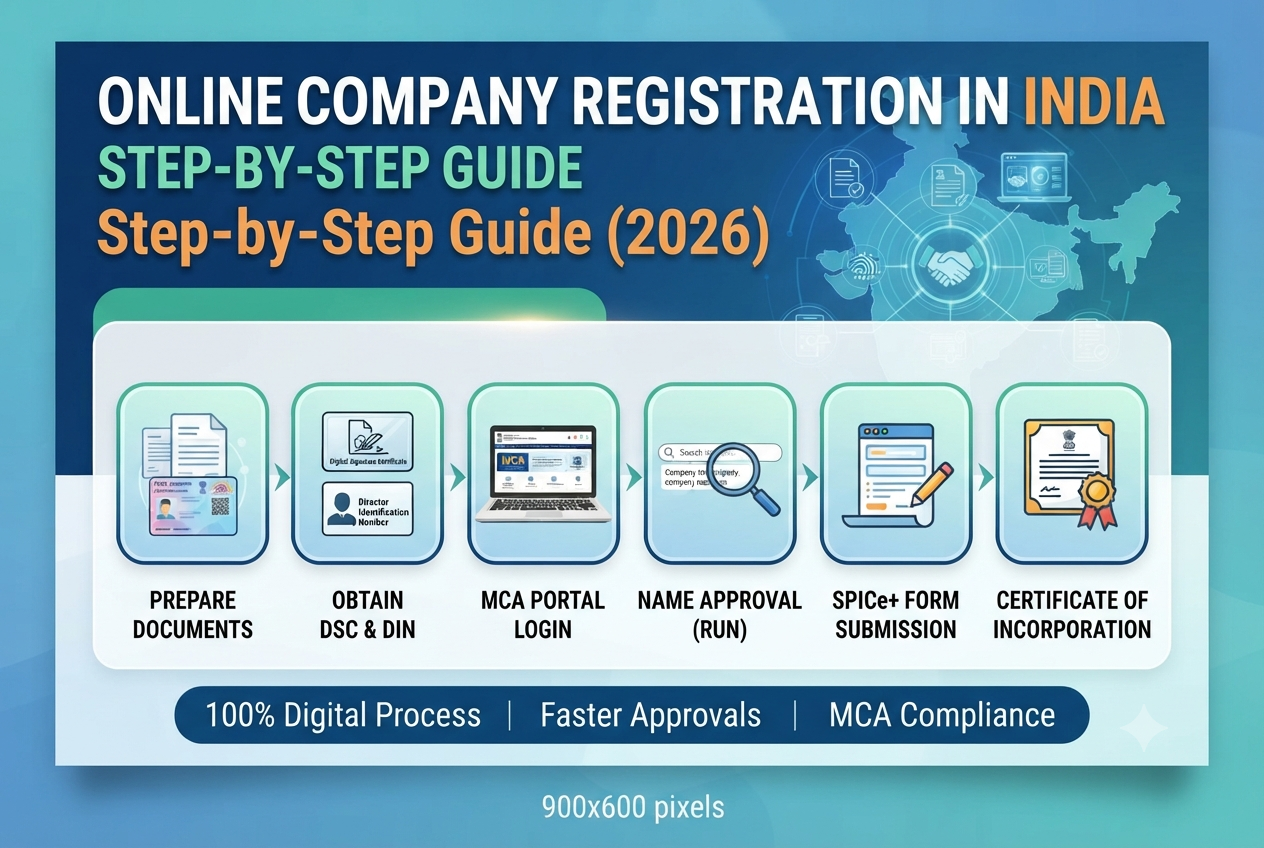
Launching a business in India requires far less paperwork than it once did. Founders can incorporate a company through the Ministry of Corporate Affairs (MCA) V3 portal. The portal works from anywhere in the country. You do not need to visit a government office. Whether you launch a tech startup, a family business, or a solo consultancy, the digital workflow matters. Learning it early helps your legal entity start smoothly.
Completing an online company registration in 2026 revolves around the MCA’s integrated web form, SPICe+ (Simplified Proforma for Incorporating Company Electronically Plus). This single digital gateway streamlines business setup into one unified workflow. It handles name reservation, company incorporation, and Director Identification Number (DIN) allotment. Additionally, it covers PAN, TAN, and essential statutory tax or labor registrations. Instead of juggling multiple government departments, founders submit one consolidated application and receive their Certificate of Incorporation electronically.
Choosing the Right Business Structure
Before accessing the MCA portal, decide which legal structure matches your operational goals, liability tolerance, and funding plans. Each entity type carries distinct compliance obligations and ownership rules under the Companies Act, 2013, and related statutes:
- Private Limited Company (Pvt Ltd): The standard choice for startups and scalable businesses looking to raise venture capital or issue employee stock options. It requires a minimum of two directors and two shareholders (who can be the same individuals) and offers strong limited liability protection.
- One Person Company (OPC): Designed for solo entrepreneurs who want full ownership alongside limited liability. An OPC requires only one member and one director, plus a designated nominee who steps in if the sole member becomes incapacitated.
- Limited Liability Partnership (LLP): Ideal for professional service firms, consultants, and small partnerships that do not plan to raise equity funding. An LLP blends the operational flexibility of a partnership with limited liability and uses the FiLLiP form rather than SPICe+.
- Section 8 Company: Built for non-profit organizations promoting education, art, science, charity, or environmental protection, where all profits are reinvested into the organization’s objectives.
Essential Documents Required Before You Apply
Having digitized, self-attested documents ready before starting your application prevents costly resubmissions. Prepare clear PDF scans of the following records:
- Identity and Address Proof of Directors and Shareholders: PAN card (mandatory for Indian nationals), passport (mandatory for foreign nationals, properly notarized and apostilled), and a recent address proof such as a bank statement, electricity bill, or mobile bill not older than two months.
- Registered Office Proof: A recent utility bill (electricity, water, or gas) showing the premises address, paired with a No Objection Certificate (NOC) from the property owner. If the property is rented, attach a valid lease or rent agreement. Residential addresses are completely acceptable as a registered office.
- Consent and Declarations: Signed consent from each proposed director to act in that role (Form DIR-2) and compliance declarations from initial subscribers.
Step-by-Step Incorporation Process on the MCA Portal
Once your structure is finalized and documents are organized, work through the incorporation sequence in order:
- Obtain Class 3 Digital Signature Certificates (DSCs): Every proposed director and subscriber must acquire a Class 3 DSC from a licensed certifying authority. Since the entire process is paperless, DSCs serve as your legal electronic signature on all incorporation forms. Verification happens via quick video KYC, typically issuing the certificate within 24 hours.
- Reserve Your Company Name via SPICe+ Part A: Log in to the MCA V3 portal as a business user and open SPICe+ Part A. You can propose up to two names alongside your business activity code. Check the MCA name index and the Indian Trademark Registry beforehand. Doing so helps you avoid rejections caused by identical or phonetically similar names. Once approved—usually within one to three working days—the name remains reserved for 20 days.
- Complete SPICe+ Part B: Within that 20-day window, fill out Part B with your registered office address, authorized and paid-up share capital, director details, and shareholding distribution. If any director lacks a DIN, SPICe+ generates it automatically for up to three directors.
- Draft and Link e-MoA, e-AoA, and AGILE-PRO-S: Part B connects directly to mandatory linked web forms. File INC-33 (e-MoA) to define your company’s business objectives and capital structure, and INC-34 (e-AoA) to establish internal governance rules. At the same time, complete Form INC-35 (AGILE-PRO-S). This single form covers multiple registrations. Use it to apply for your company bank account, EPFO, and ESIC. You can also apply for professional tax if it applies in your state. You can also use this form for optional GST registration, while submitting Form INC-9 for subscriber declarations.
- Professional Certification and Fee Payment: A practicing Chartered Accountant (CA), Company Secretary (CS), or Cost Accountant (CMA) must digitally certify the SPICe+ form. Companies incorporating with an authorized capital of up to ₹15 lakh pay zero government filing fees for SPICe+. This exemption applies under current MCA fee rules. However, state-specific stamp duty on the MoA and AoA still applies. Affix all DSCs and pay the consolidated challan online.
- CRC Verification and Certificate of Incorporation: The Central Registration Centre (CRC) scrutinizes your submission. If minor discrepancies appear, the CRC allows up to two resubmissions to fix them. Once approved, the MCA emails your Certificate of Incorporation. This document includes your unique Corporate Identity Number (CIN), along with your newly allotted PAN and TAN.
Post-Incorporation Compliance Checklist
Receiving your incorporation certificate marks the start of statutory governance. Complete these immediate tasks to keep your company compliant from day one:
- Open a Current Bank Account: Activate the corporate bank account requested through AGILE-PRO-S and deposit the subscribed share capital from each shareholder’s personal account.
- File Form INC-20A (Commencement of Business): Within 180 days of incorporation, file a declaration confirming that every subscriber has paid the value of the shares agreed to be taken. You cannot legally commence business operations or borrow funds until INC-20A is filed.
- Appoint the First Statutory Auditor: Hold your first board meeting within 30 days of incorporation to appoint a practicing Chartered Accountant as the company’s first auditor and file Form ADT-1.
Founders can establish a legally compliant enterprise in roughly a week. To achieve this, they must prepare accurate documentation and verify name availability early. Following the MCA V3 workflow carefully ensures the process goes smoothly.. Leveraging company registration online eliminates bureaucratic delays and gives your business the legal credibility required to sign contracts, onboard clients, and attract investors right from launch.
