Colombia fits a new blow to its difficult relationship with the United States of Donald Trump. The Republican has chosen to disapprove of the performance of the Andean country in the anti -drug fight, the dreaded descertification, according to Gustavo Petro. “The United States gives us after dozens of dead,” said the president of Colombia on Monday night during a Council of Ministers, moments before the official announcement, without detailing whether Washington also applied the except or except measure Waiver to avoid the hardest sanctions.
Petro, which is under enormous pressure to show results on that forehead, must now deal in the final stretch of his mandate with the consequences that accompany that new stigma that the White House puts. Also, with the fact of it is the first time in three decades that Colombia falls into the list of countries that do not cooperate in the fight against drug trafficking, a turning back in the time that evokes the memory of strong years.
“In Colombia, the cultivation of coca and cocaine production have reached historical records under President Gustavo Petro, and their failed attempts to reach agreements with the narco -terrorist groups have only exacerbated the crisis,” says the White House memorandum published instantly after the announcement in Bogotá. “The Colombian government has not even fulfilled its own coca eradication goals, which were considerably reduced, which has undermined years of mutually beneficial cooperation among our countries against narcoterroristas. For this reason, I have designated that Colombia has manifestly breached its obligations in drug control,” adds the text signed by Trump, which leaves the country in the same group of Bolivia, Venezuela and Myanmar.
“Colombia’s breach of its obligations in drug control during the last year is due exclusively to its political leadership,” he adds in one of his toughest lines, which underlines Trump’s animosity to the Petro’s left government. Matizes, however, that assistance to Colombia is vital for the interests of the United States, which opens the door to exception measures to maintain cooperation.
A message posted by the State Department in its X account somewhat less than an hour later speaks of a “denied leadership” of Petro and clarifies that the US government “has issued an exemption so that the crucial cooperation of the United States, including anti -narcotics, can continue. The results matter: we must see progress and should be soon!”.
Colombia is by far the first world cocaine producer, but it has also been a narrow ally of the United States, which had only degraded it in that classification in time of former president Ernesto Samper (1994-1998). Illicit crops in the Andean country remain at unprecedented levels, and do not seem to find a roof. At the end of 2023, its extension reached 253,000 hectares, according to the United Nations Illicit Crops Integrated System (SIMCI). While that is considered the official figure, other measurements anticipate an even greater rise when the data is updated.
“Although the certification process is based on clear criteria, the decision is made by the US President and is deeply influenced by political and diplomatic considerations,” explained Elizabeth Dickinson, an analyst at the International Group Crisis (ICG). “The previous administrations have repeatedly certified Colombia despite concerns about insufficient compliance because, in their opinion, maintaining close cooperation with Bogotá was more favorable for Washington.”
Five more times
Since 2013 – when there were only 48,000 hectares – the extension of coca leaf crops has been quintupled. During his first mandate, Trump had already hinted that he intended to discertify Bogotá, but never executed that threat.
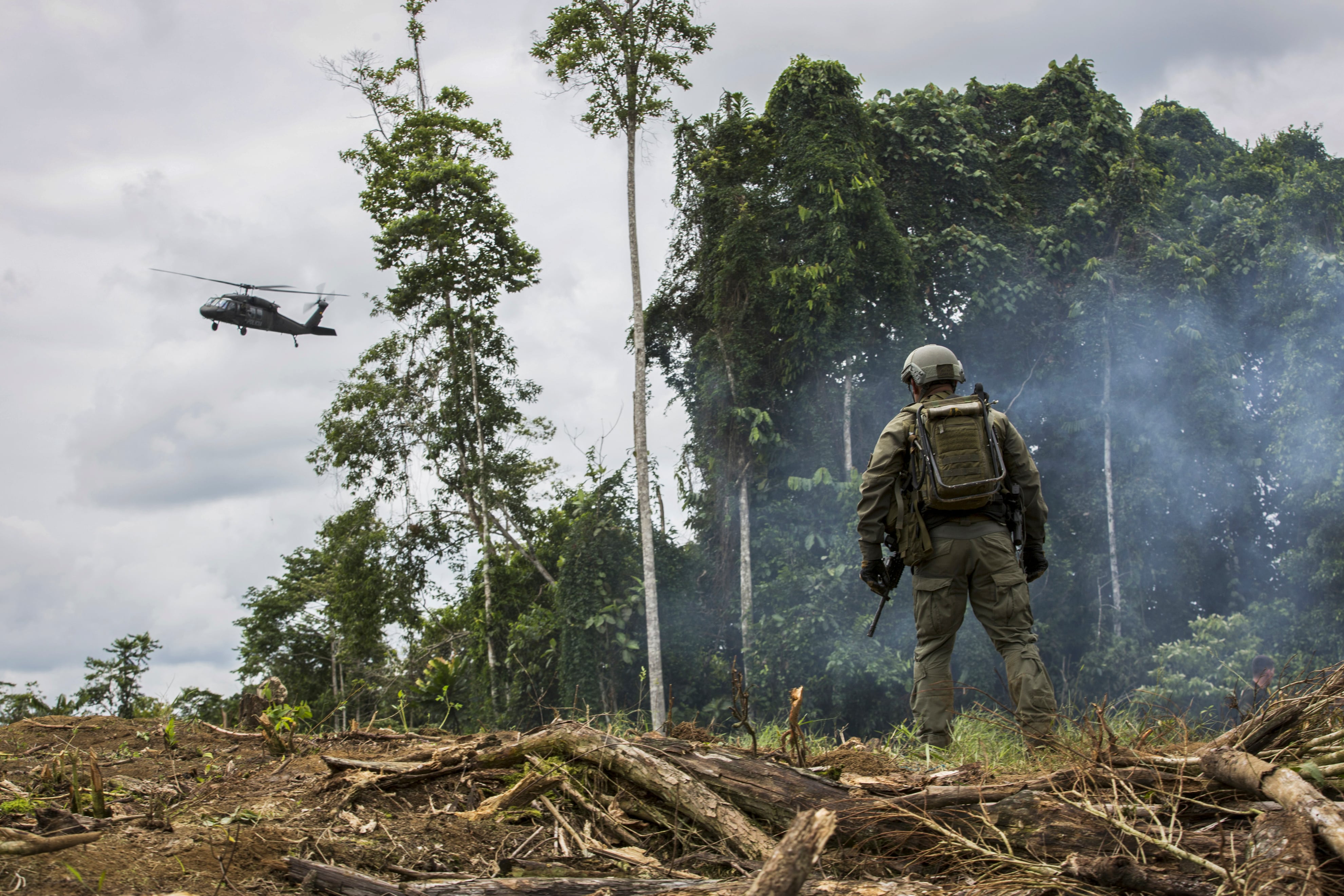
Although Petro has collided on more than one occasion with the administration of the Republican, Colombia needs American help to face the security threats that represent the dissidents of the extinct FARC guerrillas, drug trafficking bands or the ELN guerrillas, among others. Moreover, after total peace policy, which intended to negotiate simultaneously with all armed groups, has blurred without great achievements to show.
To the growth of narcocultures, the collapse is added in forced eradication, with less than 10,000 hectares last year, the data that has most doubts in the United States about Bogotá’s degree of commitment. In the midst of that evaluation, the Petro government tried to emphasize the increase in cocaine seizures, a variable that directly hits drug traffickers and not to peasants who sow the coca bush. In 2024 the authorities of the South American country were seized from about 900 tons, a significant increase compared to 746 of 2023. In the first half of this year, more than 500 tons were.
In that context, in Colombia for months the three possible scenarios were expected with great expectation: a full certification that was unlikely; a partial descertification – a kind of general exemption based on national security considerations, without punitive measures – or a total descertification. Both the Minister of Defense, the Retiro General Pedro Sánchez, and the ambassador to Washington, Daniel García-Peña, have transmitted the message that the only ones that benefit from the descertification are the criminals.
“Withdrawing cooperation funds would weaken Colombia by affecting its legal economy,” Garcia-Peña wrote last week in The Washington Post. “And it would also weaken the United States by reducing the capacity for maritime and aerial interdiction, and by obstructing intelligence flow.”
The descertification, however, was probable, as noted by an analysis of the Colombian American Chamber of Commerce, Amcham. At a time when the traditional bipartisan support in the American Congress with respect to Colombia has eroded and the relations between Bogotá and Washington have tensioned, Bogotá also sent contradictory signals as the intention to negotiate with the Gulf clan as part of the total peace or the alignment messages with the regime of Nicolás Maduro in the neighbor Caribbean
The decision to decept, warn of observers, can activate a series of sanctions that include freezing the help that the White House gives annually or greater difficulties in accessing loans from the International Monetary Fund, from the blocking of credits to other commercial and tariff sanctions, a garrote that Trump frequently uses. It can also restrict sales of military equipment or intelligence cooperation. Its scope is only known over time. In the case of partial descertification, the so -called Waiver o Exception measure allows the United States to maintain help if you consider that freezing it can affect its national security interests, as the case of Colombia points out.
“A total descertification could be devastating for Colombia, since it would affect all bilateral aid, not only the assistance related to anti -drug policy,” Dickinson warned in the ICG analysis. “Historically, Washington’s support to Colombia has included funds from multiple US sources, such as the Department of Defense, the State and USAID department.” The drastic cut in the help of USAID by Trump has already represented a hard blow to Colombia, which, however, still receives substantial support.
Trump and Petro already collided at the beginning of this year on the repatriation flights that the Colombian at first rejected for what he considered an unworthy treatment with the deportees who flew handcuffed. Then, the tariff threat of the Republican appeared the Colombian economy to the precipice, but the crisis was resolved in less than 24 hours and Colombia today has the minimum tariff of 10%. The episode, however, was an omen of turbulence to come between two leaders in the ideological and prone antipodes to fix positions to social networks.
For more updates, visit our homepage: NewsTimesWire