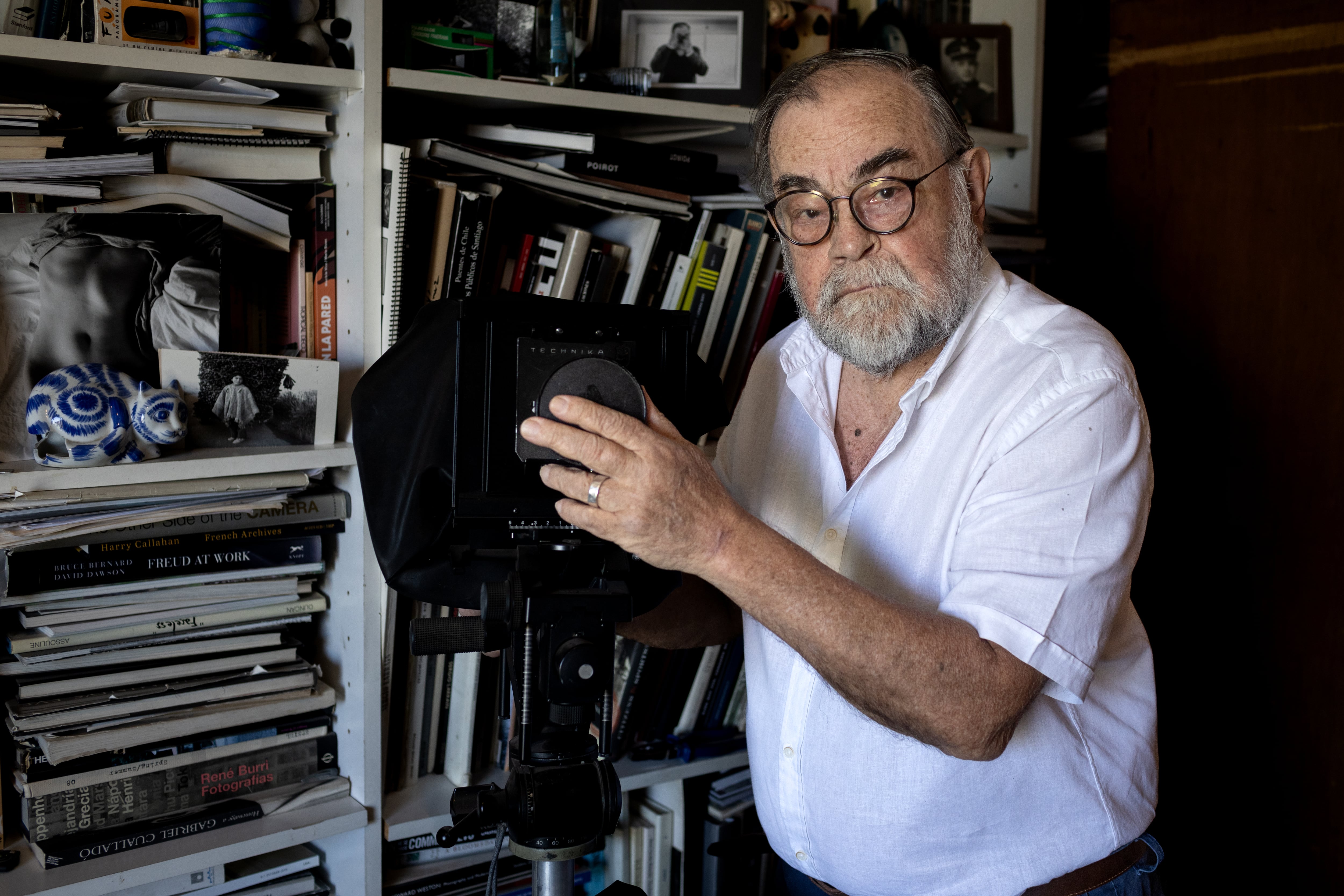
Although the former US president Richard Nixon was not the material author of the bombing of the La Moneda Palace in Santiago de Chile in 1973, he was an outstanding instigator of the coup d’etat perpetrated by Augusto Pinochet. “I was facing Nixon and I knew that there were accounts to settle. I looked for the appropriate light and angle to give that ghostly to the tyrant,” says Chilean photographer Luis Poirot, 84, in a sequence of the documentary Poirot, last witness. The film, the work of the journalist Francesc Relea, leads to Docs, the International Documentary Film Festival of Barcelona a large part of the unpublished archive of his friend and partner. Relea saw in Poirot an unusual, leisurely, meditative artist. Witness of crucial chapters in Chile and Spain, from the Popular Unit led by the reformism of Salvador Allende to the social outbreak of its homeland in 2019, Poirot and Relea crystallize on the screen the memory of a society that, as the Spanish journalist explains, is one of those that surprises.
Poirot’s way of working deeply hit Relea. He is aware that the frantic rhythm and sometimes depersonalized of the digital age mark the final result. “I met Poirot on one of my trips to Chile while working as a correspondent for the country in Buenos Aires. We went to the Military School, where he was cadet.” A period that, despite winning in discipline, Poirot defines as the blackest of his life: “There I saw immediately that he was not a photographer to use.”
The documentary affects how relative the memory can result when it is in the hands of one or the other. For this reason, the characters to which the artist allowed them to open on the channel in front of the diaphragm of his Hasselblad’s diaphragm. The feature film gives life to these portraits, among which is the frown of the Catalan singer -songwriter Joan Manuel Serrat; the teson of the writer Pablo Neruda in his home in Isla Negra; the nostalgia of youth years and struggle shared with Isabel Allende; or the portraits of the tortured and murdered composer Víctor Jara. “Maybe I’m a photographer because I am terror for absence,” Poirot acknowledged.
His negatives also faced absence and oblivion. After the coup and death of Salvador Allende, Poirot was exiled to France, and then to Spain, where he assured in the documentary that reached the high point of his career. In Barcelona he immortalized the return of the exile of Federica Montseny, former minister of the Second Republic; Dolores Ibaurri The passionate; Salvador Dalí; Agustí Centelles; Julio Cortázar; Even Jordi Pujol sounding the snot in the halls of the Parliament of Catalonia.
The feature film not only projects the dialogue between Poirot and the memory, but also passes through an amalgam of its own emotions such as aging, the deterioration of family ties or the loss of optimism of manifestations in favor of a change within Chilean society.
“They no longer make manifestations like this, right Joan Manuel?” Asks the photographer by showing part of his file to the Catalan singer -songwriter.
“There is also no spirit of before,” he says in the film Serrat.
For more updates, visit our homepage: NewsTimesWire