
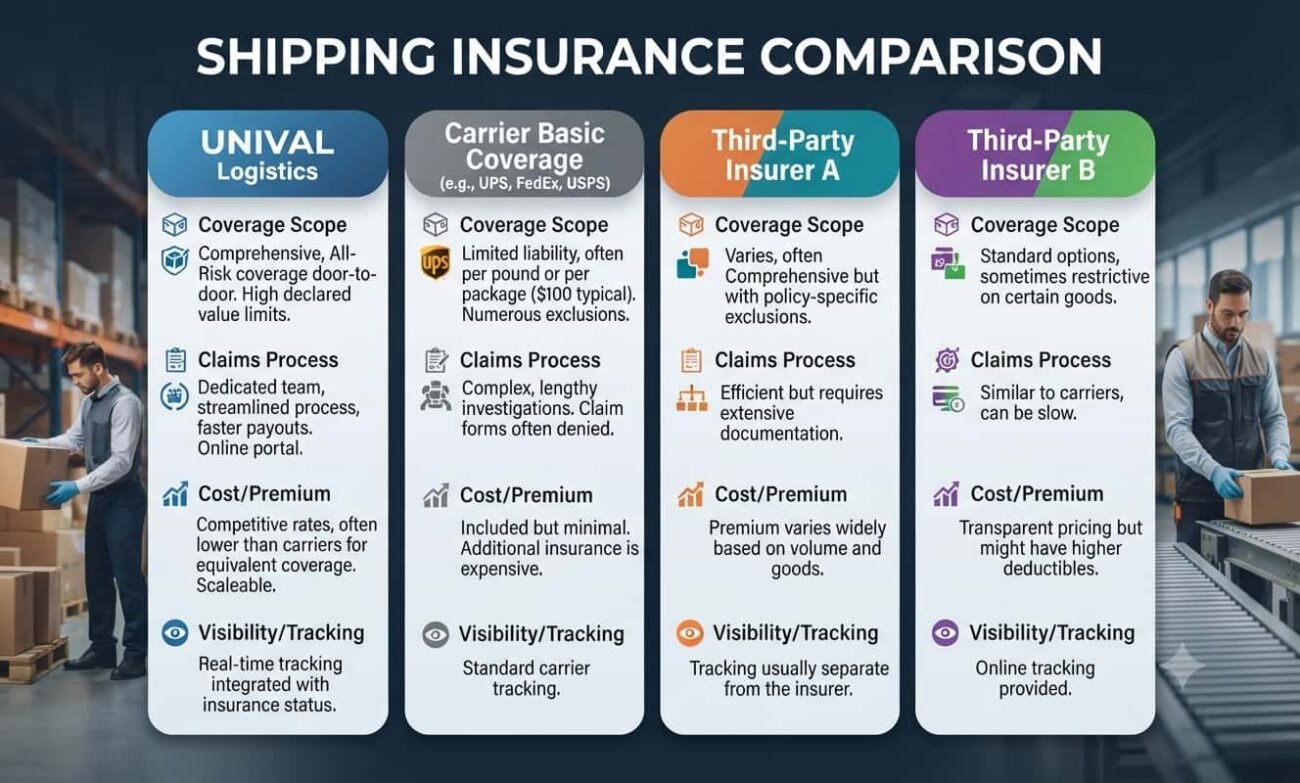
Summary: Businesses shipping valuable products need to understand the difference between carrier declared value and third-party shipping insurance. Carrier declared value increases the maximum amount a carrier may be liable for under its transportation terms, but generally requires proof that the carrier caused the loss or damage. Third-party insurance is a separate insurance policy that may cover eligible losses regardless of carrier negligence, depending on its wording and exclusions. Costs, coverage limits, claims procedures and eligible commodities vary. UNIVAL Logistics helps businesses evaluate their shipping requirements and explore practical, cost-effective protection options.
Overview: Shipping protection is an important consideration for ecommerce companies, retailers, manufacturers, jewelry businesses and organizations sending expensive equipment. A carrier’s standard liability may not cover the full value of a shipment, while a third-party policy may offer broader protection at an additional premium. Understanding how each option works helps businesses control financial exposure, manage shipping expenses and improve customer confidence. This guide explains the differences, advantages, limitations and costs of both options.
Key Takeaways:
- Carrier declared value increases the carrier’s potential liability under its shipping terms. It is not automatically an insurance policy.
- Third-party shipping insurance is a separate policy governed by its coverage terms, exclusions and claim requirements.
- Carrier claims generally require evidence that the carrier is responsible for the loss or damage.
- Third-party policies may cover eligible losses without requiring proof of carrier negligence.
- Premiums and declared value charges depend on shipment value, service, destination, commodity and risk.
- Both options have exclusions, documentation requirements and coverage limits.
- UNIVAL Logistics helps businesses evaluate shipping risks and identify cost-conscious protection arrangements.
Quick Answer
Carrier declared value increases the shipping carrier’s potential liability for an eligible shipment, while third-party shipping insurance provides separate insurance coverage under a policy. Declared value may be suitable for certain routine shipments, but third-party protection can offer broader coverage for valuable goods. The right choice depends on the product, shipment value, exclusions, claim conditions and total cost. UNIVAL Logistics helps businesses compare practical shipping protection options.
What Is Carrier Declared Value?
Carrier declared value is the amount a shipper states when booking a shipment to increase the carrier’s potential financial liability above its standard limit. It is available through major shipping companies, although the permitted amounts, fees and conditions vary by carrier and service.
For example, FedEx generally includes a $100 standard liability allowance for most U.S. package services. Eligible shippers can pay an additional charge to declare a higher value, subject to service maximums and commodity restrictions. UPS also offers declared value options, with limits and fees depending on the service and applicable terms.
However, declaring a shipment value does not mean the carrier has automatically insured the goods. The carrier generally investigates a claim and determines whether it is responsible under its transportation agreement. The shipper may need to provide proof of the loss, evidence of damage and supporting documents showing the actual value.
The amount paid may also be restricted by the item’s repair cost, depreciated value or replacement cost, depending on the carrier’s terms. If a shipment is damaged because it was inadequately packaged, for example, the carrier may reject the claim.
Declared value can be useful when the shipment qualifies for the service and the carrier’s liability conditions meet the business’s requirements. However, it should not be confused with comprehensive protection.
What Is Third-Party Shipping Insurance?
Third-party shipping insurance is a separate insurance arrangement purchased through an insurance company, broker or specialist shipping protection provider. Unlike carrier declared value, it is not simply an increase in the transportation company’s liability limit.
A third-party policy may protect eligible shipments against covered loss or damage during transit. Depending on the policy, protection may apply even when the carrier was not negligent or cannot be proven responsible for the incident.
For example, a retailer sends a valuable electronic device to a customer. The parcel is damaged during transportation, but the available evidence does not clearly establish which party caused the damage. Under carrier declared value terms, the claim may be difficult to approve if carrier responsibility cannot be demonstrated. A suitable third-party policy may provide another route to compensation, subject to its coverage conditions.
What Can Third-Party Shipping Insurance Cover?
The actual coverage depends on the policy, but common areas to investigate include:
- Physical damage: Accidental damage to eligible products during covered transit.
- Loss in transit: Eligible shipments that are lost while being transported.
- Theft: Theft during a covered stage of transit, subject to security and reporting requirements.
- Door-to-door transit: Coverage from the agreed collection point to the approved delivery destination.
- International shipments: Protection for eligible cross-border shipments, depending on the destination and policy.
- Shipping expenses: Some policies may include eligible transportation costs in addition to the insured goods’ value.
Not every policy includes all these benefits. Businesses should review the policy wording, insured value calculation, deductibles, exclusions and claim deadlines before purchasing coverage.
Shipping Insurance Comparison: The Main Differences
Understanding how the two options operate is the first step toward choosing suitable protection. Although both can increase financial protection for eligible shipments, their responsibilities and claim procedures are different.
1. Coverage Structure
Carrier declared value increases the carrier’s potential liability under its transportation terms. The carrier remains responsible for investigating the claim and determining whether it is liable.
Third-party insurance is a separate agreement between the insured party and an insurer. The insurer evaluates the claim according to the policy rather than relying exclusively on the carrier’s liability conditions.
This distinction is especially important for businesses shipping expensive goods. A company may have declared the full eligible value with a carrier but still face a rejected claim if the carrier determines that it was not responsible for the loss.
2. Financial Protection
Carrier declared value is subject to service-specific maximums, commodity restrictions and liability conditions. Even when a higher amount is declared, the carrier may not reimburse the full declared amount.
Third-party insurance may provide protection based on the insured value and policy terms. Some policies cover the invoice value or replacement value of eligible goods, while others apply different valuation methods, deductibles or limits.
Businesses should confirm whether the policy covers the actual financial exposure they want to protect.
3. Claim Responsibility
With declared value, the claim is generally submitted to the carrier. The shipper must provide supporting evidence and demonstrate that the carrier is responsible under the applicable terms.
With third-party insurance, the claim is submitted to the insurer or its claims administrator. The insurer assesses the incident against the policy conditions. A claim may be eligible even when carrier negligence is not established, provided the event is covered.
4. Coverage Flexibility
Carrier declared value is restricted by the carrier’s service rules and eligible commodities. Certain products, such as jewelry, artwork, antiques and precious metals, may have lower limits or special conditions.
Third-party insurance may offer more flexible limits and coverage arrangements for different product categories. However, specialist goods can still require additional underwriting, approved packaging, secure handling or specific shipping procedures.
5. Claims Experience
Carrier claims can require detailed evidence that the transportation company caused the loss or damage. The investigation may involve tracking records, delivery information, packaging inspections and proof of value.
Third-party claims follow the insurer’s own process. The documentation may include invoices, shipping records, photographs, proof of coverage and evidence of the incident. The actual processing time depends on the provider, policy and complexity of the claim.
Advantages and Disadvantages of Carrier Declared Value
Carrier declared value can be convenient because it is usually selected during shipment creation. Businesses do not necessarily need to arrange a separate policy for every eligible parcel.
Advantages
The main advantage is simplicity. Shippers can enter the declared value when preparing the shipping label and pay the applicable fee through the carrier’s billing process. The arrangement can be practical for routine shipments where the value is within the carrier’s permitted limits.
It can also be suitable for businesses that ship ordinary products with relatively predictable replacement costs. When the shipment qualifies and the carrier is responsible for the loss or damage, the increased liability may provide useful financial protection.
Disadvantages
The biggest limitation is that declared value is not comprehensive insurance. The shipper may need to establish carrier responsibility, and the carrier’s maximum liability may be restricted by the service or commodity.
Some products have lower declared value limits than ordinary parcels. Improper packaging, prohibited goods and other exclusions can also affect claim eligibility.
For businesses shipping expensive jewelry, artwork, specialist electronics or valuable equipment, these restrictions can create a financial gap between the product’s actual value and the protection available through the carrier.
Advantages and Disadvantages of Third-Party Shipping Insurance
Third-party insurance can be useful for companies that need a separate layer of financial protection for valuable products.
Advantages
A major advantage is the potential for broader coverage. Depending on the policy, eligible losses may be covered without proving that the carrier was negligent.
Third-party providers may also offer flexible insured values, multi-carrier arrangements and protection for businesses that ship through different transportation companies. This can make policy management easier for ecommerce operations with several shipping channels.
Some policies may include additional eligible costs, such as shipping expenses or replacement-related expenses. Businesses should verify these benefits in writing rather than assume they are included.
Disadvantages
Third-party insurance has its own cost and administrative requirements. The shipper must understand the policy, maintain accurate records and comply with the insurer’s security, packaging and reporting conditions.
Certain products may be excluded or require special approval. Deductibles, coverage limits, territorial restrictions and claim deadlines can also affect the amount a business receives.
A policy with a low premium may not be the most suitable option if it contains exclusions that affect the products being shipped.
Which Option Is Better for Different Businesses?
The right protection depends on the goods, shipment value, delivery method and financial risk. A practical shipping insurance comparison should consider the actual needs of the business rather than simply selecting the lowest advertised fee.
Ecommerce Businesses
Ecommerce retailers often send large numbers of parcels to residential customers. For lower-value products, the carrier’s standard liability or declared value may be sufficient for some shipments.
However, businesses selling expensive electronics, designer products or specialist equipment may benefit from reviewing third-party insurance. A suitable policy can help manage the financial impact of covered loss or damage, particularly when a company ships through multiple carriers.
UNIVAL Logistics helps ecommerce businesses consider shipping value, handling requirements and protection costs when planning their logistics operations.
Jewelry and Watch Retailers
Jewelry and luxury watches can have high individual values and specific handling requirements. Standard carrier declared value limits may be restrictive for these products.
Third-party coverage or an eligible specialist shipping program may be more appropriate, depending on the goods and destination. Businesses should confirm whether gemstones, precious metals, watches and finished jewelry are accepted and whether special security procedures apply.
UNIVAL Logistics can help businesses evaluate shipping arrangements for valuable goods and identify questions to resolve before dispatch.
Electronics and Technology Companies
Laptops, cameras, mobile devices and specialist electronic equipment may be exposed to theft, impact damage and handling risks.
A business should examine whether its carrier’s liability terms provide enough protection for the shipment value. Third-party insurance may be worth considering when the equipment is expensive or when a loss could disrupt operations.
Art Galleries and Collectors
Artwork, antiques and collectibles can be difficult to value because their worth may depend on condition, rarity, provenance and market demand. Some carriers impose special declared value restrictions on these categories.
A specialist policy may be more appropriate, but businesses should confirm whether the insurer accepts the specific artwork, packing method, transit route and handling arrangements.
Manufacturers and Industrial Businesses
Manufacturers may ship expensive components, machinery parts, prototypes and specialist equipment. The financial impact of a damaged shipment can extend beyond the item’s replacement cost if production or installation is delayed.
Businesses should review both the direct value of the goods and any additional costs that may be covered under a suitable policy.
How Much Does Shipping Protection Cost?
The cost depends on the selected carrier or insurer, shipment value, product category, destination, shipping method and risk profile. There is no single rate that applies to every parcel or business.
Carrier declared value charges are generally calculated using the carrier’s published rate structure. Third-party insurance premiums are determined by the insurer’s pricing model and underwriting requirements.
Carrier Declared Value Costs
For eligible shipments, carriers generally include a basic liability allowance in the transportation rate. Additional declared value fees apply when the shipper requests a higher liability amount.
The final charge may depend on the declared value, service, package type and applicable fee schedule. For example, FedEx and UPS use incremental charges for eligible U.S. package shipments, but their current rates and calculation methods are not necessarily identical.
Third-Party Insurance Costs
Third-party insurance premiums may be calculated as a percentage of the insured value or through a provider-specific pricing structure. The rate can change according to the type of product, shipping frequency, destination, security procedures and claims history.
A business shipping ordinary retail products may receive a different quote from a company shipping jewelry, fine art or precious metals.
Additional Expenses to Consider
When evaluating the total cost of protection, businesses should account for:
- Carrier declared value fees: Additional charges for increasing the carrier’s liability above its included allowance.
- Third-party insurance premiums: The quoted price for the selected insurance coverage.
- Deductibles: The amount the insured may need to pay before eligible insurance benefits apply.
- Packaging expenses: Protective materials, reinforced cartons, tamper-evident packaging and specialist packing services.
- Security and handling costs: Signature services, approved collection arrangements or additional handling requirements where applicable.
- Administrative costs: Staff time spent maintaining records, managing policies and preparing claims.
The cheapest option is not necessarily the best value. Businesses should compare the total premium or fee against the protection provided, exclusions and potential financial loss.
Important Disclaimer
The costs discussed above are general pricing categories, not fixed quotations or guaranteed insurance rates. Actual prices are baseline estimates where applicable and are subject to market fluctuations, supplier changes, insurer underwriting decisions and variable logistics fees. Carrier charges and third-party premiums may change according to shipment value, product type, destination, service and coverage conditions. For the latest and most accurate prices, please contact UNIVAL Logistics for professional guidance and a shipment-specific cost assessment.
How to Choose the Right Shipping Protection
Before selecting a protection option, businesses should examine their shipment profile and identify the risks that could create the greatest financial impact.
Step 1: Calculate the Actual Shipment Value
Determine the appropriate value of the goods using invoices, purchase records or professional valuations. Consider whether the relevant amount should reflect the purchase price, selling price, repair cost or replacement cost under the proposed coverage terms.
Step 2: Check Carrier Restrictions
Review the carrier’s declared value maximums, restricted commodities, packaging requirements and claim conditions. Do not assume that every product qualifies for the same liability limit.
Step 3: Review the Third-Party Policy
Check the policy’s insured value, covered events, exclusions, deductible, territorial limits and claim notification deadlines. Confirm that the actual goods and shipping route are eligible.
Step 4: Compare the Total Cost
Calculate the carrier’s additional declared value fee and compare it with the third-party insurance premium. Include packaging, security and administrative expenses where relevant.
Step 5: Evaluate the Claims Process
Consider how quickly claims must be reported, what evidence is required and which organization handles the investigation. A clear and manageable claims process can be important for businesses shipping regularly.
Step 6: Match Protection to Business Risk
A company shipping inexpensive goods may not need the same coverage as a retailer sending luxury watches or a manufacturer transporting specialist equipment. Select protection based on actual financial exposure and policy eligibility.
How UNIVAL Logistics Helps Businesses Make Cost-Effective Shipping Decisions
UNIVAL Logistics understands that valuable shipments require careful planning. Choosing between carrier declared value and third-party protection involves more than comparing two prices. Businesses need to consider the value of their products, transportation requirements, handling procedures and potential financial exposure.
Practical Shipping Guidance
UNIVAL Logistics helps businesses understand the factors that influence shipment protection. This includes product value, carrier restrictions, packaging requirements and the importance of maintaining supporting documentation.
Cost-Conscious Logistics Planning
A protection option should provide appropriate value without creating unnecessary shipping expenses. UNIVAL Logistics helps businesses evaluate the overall cost of transportation and protection so they can make informed, budget-conscious decisions.
Support for Valuable Products
Different products require different handling considerations. Jewelry, watches, electronics, artwork and specialist equipment may need additional planning before dispatch. UNIVAL Logistics helps businesses consider the relevant logistics requirements and suitable protection arrangements.
Reliable Coordination
Clear shipment information, appropriate documentation and organized logistics procedures can help businesses manage valuable shipments more effectively. UNIVAL Logistics focuses on practical coordination and service quality to support dependable shipping operations.
Better Value for Business Shipping
The most cost-effective arrangement is the one that balances protection, service quality and total shipping expenses. UNIVAL Logistics aims to provide competitive, value-focused logistics solutions that help businesses manage costs while addressing their shipping requirements. Contact UNIVAL Logistics to discuss your shipment profile and request an appropriate quote.
Common Mistakes to Avoid When Comparing Shipping Protection
Businesses can make expensive decisions when they misunderstand what a shipping protection option actually provides.
Assuming declared value is insurance: Declared value changes the carrier’s potential liability. It does not automatically create a separate insurance policy.
Choosing coverage based only on price: A low premium may come with exclusions, deductibles or restrictions that make the policy unsuitable.
Ignoring commodity restrictions: Certain goods may have lower carrier limits or require specialist insurance approval.
Overlooking packaging requirements: Inadequate packaging can affect claim eligibility under both carrier terms and insurance policies.
Failing to document shipment value: Invoices, photographs, purchase records and shipping documents help support a claim.
Not reviewing delivery risks: Theft after delivery, unattended parcels and incorrect delivery details may be treated differently under different protection arrangements.
Assuming all policies cover international transit: Territorial restrictions and destination-specific exclusions may apply. Confirm that the entire route is covered before dispatch.
Final Thoughts
Carrier declared value and third-party shipping insurance serve different purposes. Declared value increases a carrier’s potential liability under its transportation agreement, while third-party insurance provides a separate form of financial protection governed by an insurance policy.
For routine shipments, carrier declared value may be a convenient option when the goods qualify and the liability conditions are acceptable. For expensive or specialized products, third-party insurance may offer broader protection, particularly when the business needs coverage beyond carrier negligence-based liability.
The right decision depends on the shipment’s value, product category, destination, exclusions, claim requirements and total cost. A careful shipping insurance comparison helps businesses understand these differences before a parcel leaves their facility.
UNIVAL Logistics supports businesses in evaluating shipping requirements and exploring cost-effective logistics arrangements. By considering both protection and transportation expenses, companies can make more informed decisions and manage the risks associated with valuable shipments.
Frequently Asked Questions
1. What is the difference between carrier declared value and third-party shipping insurance?
Carrier declared value increases the carrier’s potential liability under its shipping terms. Third-party shipping insurance is a separate policy that may cover eligible loss or damage according to its own conditions, even when carrier negligence is not established.
2. Is carrier declared value considered insurance?
No. Carrier declared value is generally a limit of liability rather than an insurance policy. The carrier investigates claims and determines whether it is responsible under its terms and conditions.
3. Does third-party shipping insurance cover theft?
Some third-party policies cover eligible theft during transit. However, coverage depends on the policy wording, security requirements, reporting procedures and exclusions. Theft after delivery may be treated differently from theft during transportation.
4. Is third-party shipping insurance better for expensive products?
It can be a suitable option for expensive goods because some policies offer broader protection and may not require proof of carrier negligence. Businesses should confirm coverage limits, exclusions, deductibles and product eligibility before purchasing.
5. Can I purchase carrier declared value and third-party insurance together?
In some situations, a business may have both carrier declared value and separate insurance. However, the policies and carrier terms determine how claims and recoveries are coordinated. Businesses should disclose existing coverage and avoid assuming they can collect twice for the same loss.
6. How are third-party shipping insurance premiums calculated?
Premiums may depend on the insured value, product category, destination, shipping method, security arrangements, shipment frequency and claims history. Each provider uses its own pricing and underwriting requirements.
7. Does third-party insurance cover international shipments?
Some policies cover international shipments, but destination restrictions, customs requirements, transit routes and excluded countries may apply. Always confirm that the entire journey is included in the policy.
8. What documents are needed to file a shipping insurance claim?
Common documents include the shipping receipt, tracking number, insurance certificate or policy details, purchase invoice, proof of value, photographs of damaged goods and packaging, and evidence of loss or theft. The insurer may request additional documents.
9. Which shipping protection option is more affordable?
The cost depends on the shipment and the protection required. Carrier declared value may be less expensive for some eligible shipments, while a third-party policy may offer broader coverage at a higher or more competitive premium depending on the provider. Compare the total cost and actual protection rather than price alone.
10. How can UNIVAL Logistics help businesses choose shipping protection?
UNIVAL Logistics helps businesses evaluate shipment values, logistics requirements and protection considerations. Its cost-conscious approach supports informed decisions about transportation, handling and suitable shipping arrangements. Contact UNIVAL Logistics to discuss your business shipping needs
