
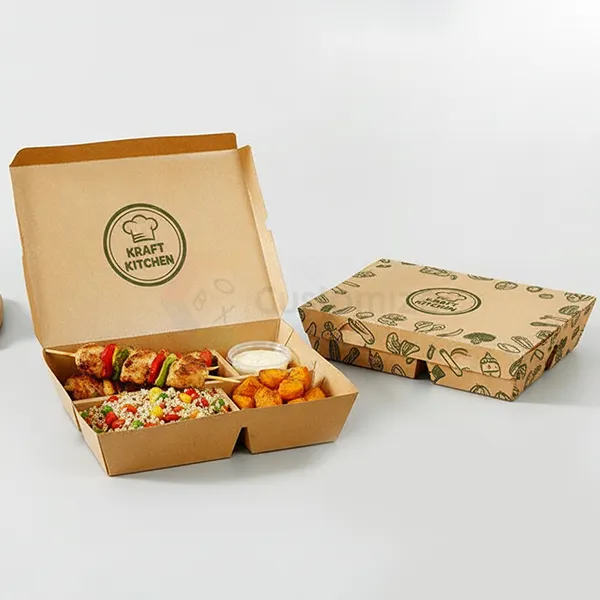
Food businesses work with different menu items, ingredients, portion sizes, and serving methods, which means packaging cannot always follow a single standard design. Custom food boxes can be created for burgers, pizza, sandwiches, bakery products, fried foods, salads, desserts, and complete meals. Each box can be designed around the product’s dimensions and serving requirements. Restaurants can also use separate packaging styles for dine-in, takeaway, catering, and delivery, allowing their packaging to match the food rather than forcing every product into the same carton.
Food Boxes for Takeaway and Delivery
Takeaway and delivery packaging must handle more than the food itself. It needs to withstand carrying, stacking, movement inside delivery bags, and the time between preparation and consumption. A box that fits the meal properly can help reduce shifting and make the order easier to handle. Depending on the menu, businesses may choose locking tabs, hinged lids, separate compartments, or stackable structures. restaurant food boxes should also be evaluated for heat, steam, grease, and moisture so that the chosen material supports the food throughout the delivery journey.
Custom Printed Food Boxes for Brand Identity
Printed food boxes give businesses a direct way to communicate their brand at the moment customers receive their orders. Logos, brand colors, typography, product illustrations, promotional messages, and QR codes can all be incorporated into packaging artwork. QR codes can connect customers with digital menus, loyalty programs, allergen information, promotional campaigns, or ordering pages when used appropriately. Rather than overcrowding every panel, businesses can create a clear design with recognizable branding and useful information. This makes packaging more informative while keeping the appearance clean and attractive.
Food-Grade Materials and Functional Coatings
Choosing the right material is one of the most important decisions when ordering custom food boxes. Paperboard, kraft board, corrugated board, and specialty coated materials are used for different food packaging applications. Dry products may require simpler paperboard, while greasy or moist foods may need a suitable barrier coating or liner. Material selection should account for the product’s temperature, oil content, moisture, weight, and direct food-contact requirements. Businesses should confirm material specifications and test packaging with their actual menu items before moving into large-scale production.
Sustainable Custom Food Packaging
Sustainability is becoming a more important part of food packaging decisions, but businesses are increasingly expected to look beyond general eco-friendly claims. Custom food boxes can be made using kraft board, selected recycled-content materials, or paper-based structures designed for particular applications. Brands should consider how the packaging will be disposed of after use, whether coatings affect recycling, and what local waste facilities accept. Choosing a simpler structure, avoiding unnecessary components, and using verified material claims can help businesses make more responsible packaging decisions without misleading customers.
Food Box Design Trends for 2026
Food packaging design in 2026 is moving toward practical functionality, cleaner visuals, brand storytelling, and more meaningful customer interaction. Minimalist artwork, readable typography, natural textures, and carefully placed branding are being used to create distinctive packaging without unnecessary clutter. Businesses are also exploring QR-enabled packaging, limited-edition designs, product information panels, and improved box structures for delivery. These approaches allow food brands to combine visual appeal with useful features, creating packaging that works both in physical settings and when customers share their food experiences online.
Wholesale Custom Food Boxes for Growing Businesses
Wholesale custom food boxes are a practical choice for restaurants, bakeries, food manufacturers, catering companies, and franchises that use packaging regularly. Ordering in larger quantities can help businesses maintain consistent packaging supplies and branding while planning inventory around sales. Companies can purchase different box styles and sizes for individual products, combination meals, seasonal menus, and promotional orders. Before placing a wholesale order, businesses should compare material quality, printing options, minimum quantities, storage requirements, production times, and costs to find a packaging solution that fits their budget and operational needs.
How to Choose the Right Custom Food Boxes
Choosing the right Custom papers Wholesale begins with understanding the product and how it reaches the customer. Businesses should evaluate food dimensions, portion sizes, heat, moisture, grease, delivery distance, and serving requirements before deciding on the box structure. Printing and branding should complement the food category, while the material needs to provide suitable performance for its intended use. Testing a sample with actual food is a useful step for checking fit, closure, stacking, and handling. A well-planned box can support food presentation, smoother operations, and a consistent brand experience.
Frequently Asked Questions
1. What are custom food boxes used for?
Custom food boxes are used to package meals, snacks, bakery products, burgers, sandwiches, desserts, and other food items. They help protect food during handling while providing a branded packaging solution for restaurants and food businesses.
2. Can custom food boxes be printed with my logo?
Yes, custom food boxes can feature business logos, brand colors, product names, illustrations, promotional messages, and QR codes to create personalized packaging.
3. Are custom food boxes available in different sizes and styles?
Yes, custom food boxes can be manufactured in various dimensions, shapes, and structures, including tuck-top cartons, hinged boxes, window boxes, compartment boxes, and takeaway cartons.
4. Which material is best for custom food packaging boxes?
Paperboard, kraft board, corrugated board, and coated food packaging materials are commonly used. The best choice depends on the food’s weight, temperature, moisture, grease, and packaging requirements.
5. Can custom food boxes handle greasy or hot food?
Some food boxes are designed with grease-resistant and moisture-resistant properties. Suitable coatings, liners, and board grades can be selected according to the specific food application and performance requirements.
6. Are custom food boxes suitable for restaurants and delivery businesses?
Yes, they are widely suitable for restaurants, cafes, food trucks, catering services, and delivery businesses. Custom structures can be designed for easier packing, carrying, stacking, and transporting meals.
7. Can I make custom food boxes eco-friendly?
Yes, businesses can explore kraft paperboard, recyclable material options, reduced packaging designs, and selected recycled-content materials. The final environmental suitability depends on coatings, material construction, food contamination, and local recycling facilities.
8. Can I order custom food boxes wholesale?
Yes, custom food boxes can be ordered in bulk for restaurants, food brands, retailers, and distributors. Wholesale orders can include different sizes, box styles, materials, and printing designs according to business requirements.
