
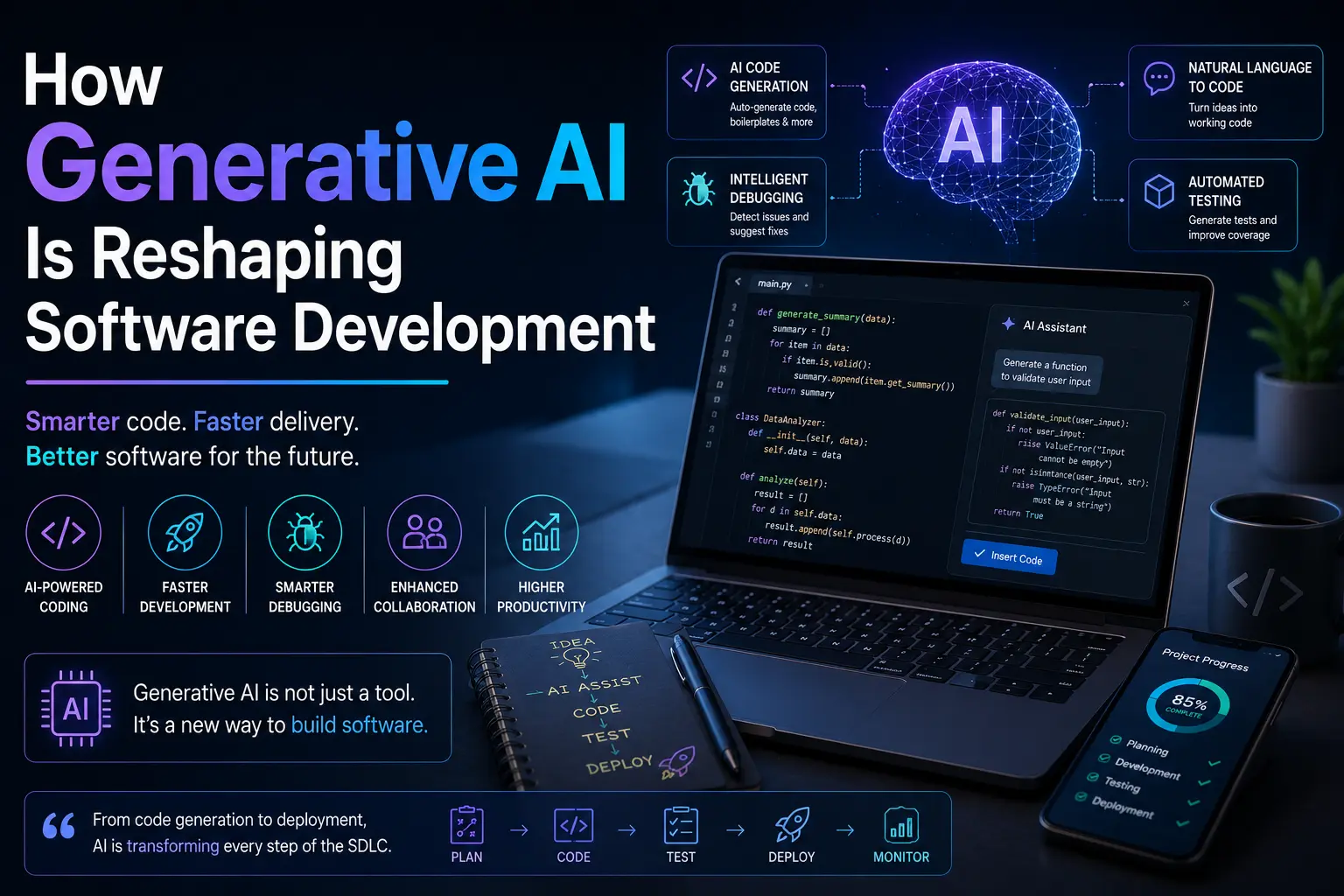
Software development has moved beyond the era of manual syntax entry. By 2026, the industry has transitioned into a collaborative model where developers work alongside intelligent systems to accelerate innovation. Generative AI is no longer a peripheral experiment; it is now a foundational driver of modern engineering, handling routine tasks while empowering humans to focus on complex architecture and strategic problem-solving.
The Transformation of Engineering Workflows
Generative AI has fundamentally changed how code moves from concept to production. Rather than spending hours on repetitive boilerplate or basic syntax, developers use AI to generate foundational logic and scaffolding instantly. This shift allows teams to iterate faster, test more thoroughly, and bridge skill gaps in unfamiliar languages or frameworks.
-
Intelligent Code Scaffolding: Developers now describe features in plain English, and AI agents generate the corresponding boilerplate, configurations, and API structures, drastically reducing time-to-market.
-
Real-Time Bug Detection: Advanced assistants monitor code as it is written, flagging potential security vulnerabilities and performance bottlenecks long before a manual review occurs.
-
Automated Testing and Documentation: AI systems autonomously generate comprehensive unit and integration tests, as well as updated technical documentation, ensuring that project assets remain current with every commit.
-
Context-Aware Refactoring: Modern tools analyze the entire codebase to suggest improvements, refactor legacy code, and optimize logic, helping to reduce long-term technical debt.
Shifts in Developer Responsibilities
The role of the software engineer is evolving from a primary “writer” of code to a “validator” and “architect.” While AI excels at speed and pattern recognition, it lacks the critical thinking required for business logic and high-level system design.
-
Defining Objectives: Developers now spend more time defining the desired outcomes and constraints for an AI agent rather than manually constructing every line of code.
-
Rigorous Validation: With AI producing a significant portion of the codebase, the human focus has shifted toward verifying that the output is secure, stable, and scalable.
-
Architectural Oversight: Engineers focus on the “big picture,” ensuring that the pieces generated by AI integrate effectively into a modular and maintainable system.
-
Prompt Engineering and Delegation: Success in the current era depends on a developer’s ability to break complex problems into smaller, manageable tasks that AI agents can execute accurately.
The Human-AI Collaboration Model
The most effective development teams in 2026 are those that have successfully balanced machine efficiency with human expertise. While AI can handle the “how” of implementation—writing loops, functions, and interfaces—the human engineer retains responsibility for the “why.” This human-in-the-loop approach is essential for maintaining code quality. By establishing clear standards for review and integrating AI assistants deliberately into the existing deployment lifecycle, organizations achieve a higher velocity without compromising the long-term integrity of their software systems.
Frequently Asked Questions
1. Is generative AI replacing human software developers?
No, it is augmenting them. AI excels at repetitive tasks, boilerplate generation, and basic debugging, which allows human developers to shift their focus toward complex problem-solving, system architecture, and business-critical logic.
2. How much of the code is actually written by AI in 2026?
Current statistics suggest that a substantial portion of new code—frequently reported at or near 50% across major tech enterprises—is AI-generated. This includes everything from routine utility functions to complex integration logic.
3. Does AI-generated code introduce more security risks?
It can. Because AI often mimics existing patterns, it may replicate insecure code or vulnerabilities. This is why rigorous human-led code reviews and automated security scanning remain more important than ever.
4. What is “vibe coding,” and is it replacing traditional programming?
“Vibe coding” refers to the trend of developers describing features in natural language and letting AI agents handle the implementation. While it accelerates prototyping, professional software engineering still requires structured, validated, and maintainable code built with human oversight.
5. How should junior developers adapt to an AI-driven environment?
Junior developers should focus on learning how to validate AI outputs, understand the underlying system architecture, and master the art of prompt engineering. AI is a powerful learning tool that can help bridge skill gaps, but critical thinking remains the most valuable asset.
