
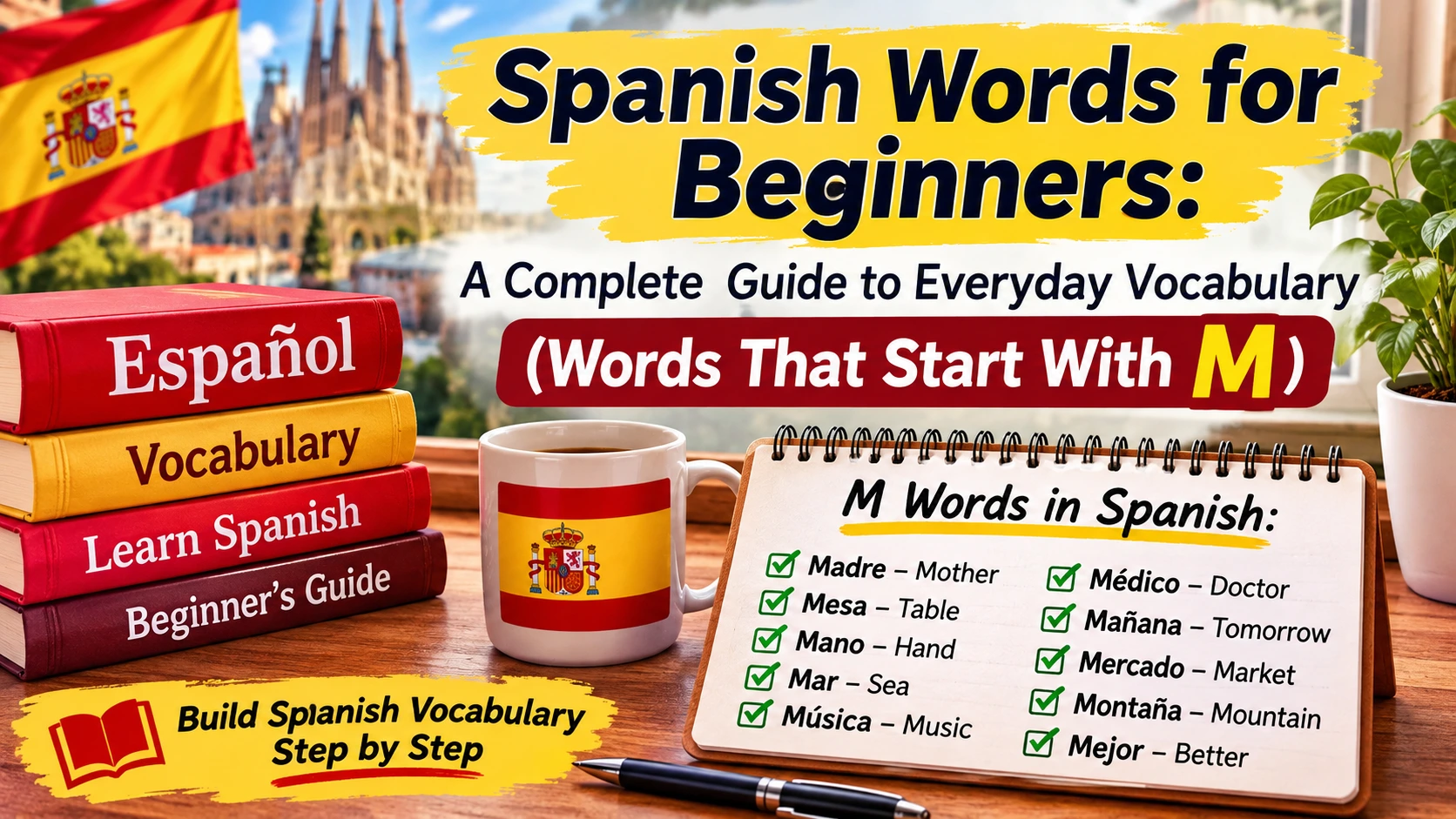
Why I Started With the Letter M
A few years ago, I was helping a friend prep for a trip to Madrid. She had three weeks, a phrasebook, and a lot of anxiety about sounding silly. So we did something a little unusual — instead of trying to memorize random vocabulary lists, we picked one letter a week and built around it. M turned out to be the richest letter we tackled. It’s packed with everyday nouns, useful adjectives, common verbs, and even city names you’ll actually need at the airport.
That’s really the point of this guide. If you’ve searched for spanish words that start with m, you’re probably not just curious — you’re trying to build real vocabulary you can use in conversation, on a trip, or for a class assignment. So let’s get into it, organized by type, with pronunciation notes and examples that go beyond a dictionary list.
Quick Answer: Common M Words in Spanish
If you only have two minutes, here are ten m spanish words you’ll hear constantly in everyday conversation:
- mesa (table)
- mano (hand)
- madre (mother)
- mundo (world)
- mañana (morning / tomorrow)
- mucho (a lot)
- mismo (same)
- momento (moment)
- mujer (woman)
- mirar (to look)
Notice something? Half of these show up in beginner textbooks in the first chapter. The other half — mismo, momento — are words native speakers use so often that skipping them leaves a real gap in your fluency. That’s the trap with a lot of vocabulary lists online: they give you nouns you’d find in a museum, not words a taxi driver or a waiter would actually say to you.
Nouns: Words That Start With M in Spanish
Nouns are the backbone of any vocabulary list, and Spanish has an unusually high number of common, high-frequency M nouns. Here’s a set worth knowing, split by how often you’d realistically use them.
Everyday essentials:
- mesa (table)
- mano (hand)
- madre (mother)
- mar (sea)
- mercado (market)
- moneda (coin/currency)
- música (music)
- maleta (suitcase)
Slightly less common but still useful:
- maestro/maestra (teacher)
- medicina (medicine)
- mentira (lie)
- milagro (miracle)
- muerte (death)
One thing worth flagging: maleta is a word I got wrong for months, mixing it up with maletín (briefcase). If you’re packing for a trip and need to say “my suitcase is heavy,” it’s mi maleta pesa mucho — not maletín, unless you’re carrying a briefcase full of documents. Small mix-ups like that are exactly why rote memorization without context doesn’t stick.
Adjectives in Spanish That Start With M
Adjectives change with gender and number in Spanish, which trips up a lot of learners. Here are some genuinely useful adjectives in spanish that start with m, with their masculine/feminine forms noted where relevant.
| Spanish | English | Note |
|---|---|---|
| mismo/misma | same | agrees with noun gender |
| malo/mala | bad | shortens to “mal” before masculine singular nouns |
| moreno/morena | dark-haired/tanned | common in descriptions |
| maravilloso/a | wonderful | slightly formal, used a lot in writing |
| molesto/a | annoying/bothered | very common in daily complaints |
| mayor | older/bigger | doesn’t change with gender |
| mejor | better | also gender-neutral |
| minucioso/a | thorough/meticulous | more advanced, useful for work contexts |
Here’s a practical tip: mayor and mejor look similar and get confused constantly by beginners. Mayor relates to age or size (“mi hermano mayor” = my older brother), while mejor means “better” (“es mejor así” = it’s better this way). I still see intermediate learners swap these two in writing.
Common Verbs Starting With M
Verbs give you the most mileage per word learned, since one verb conjugates into dozens of usable forms. A few worth prioritizing:
- mirar — to look/watch
- mostrar — to show
- mejorar — to improve
- mover — to move
- medir — to measure
- mentir — to lie
- merecer — to deserve
- manejar — to drive (common in Latin America) or “to handle/manage”
Quick regional note: in Spain, people usually say conducir for “to drive,” while manejar dominates in Mexico and most of Latin America. If you’re learning from a Spain-based textbook but plan to travel to Mexico, this kind of gap matters more than most courses admit.
Places in Spain Starting With M
If your goal is travel rather than textbook study, here’s where M gets genuinely fun. Spain has several major destinations that start with this letter, and knowing them helps with both vocabulary and trip planning.
- Madrid — the capital, obviously, and home to the Prado Museum
- Málaga — a coastal city in Andalusia, Picasso’s birthplace
- Marbella — upscale beach town, also in Andalusia
- Mallorca — the largest of the Balearic Islands
- Menorca — quieter, less touristy Balearic island
- Murcia — a region and city in southeastern Spain, known for its produce
When my friend finally made her trip, she flew into Madrid and took a train down to Málaga. The word mercado came up constantly — she visited the Mercado Central de Atarazanas there, and just knowing that one word made navigating the stalls far less intimidating. That’s the kind of practical payoff vocabulary study should give you, beyond passing a quiz.
How to Actually Remember These M Words in Spanish
Lists are useful for reference, but they’re not how vocabulary sticks. A few things that worked for us:
- Group by theme, not just by letter. Learning mesa, mano, and mujer together is less useful than grouping mesa with other furniture words, or mano with body parts.
- Say sentences out loud, not single words. “La mesa es grande” sticks better than memorizing “mesa = table” in isolation.
- Use spaced repetition apps, but don’t rely on them exclusively — apps are great for memory, weak for actual conversation practice.
- Make mistakes on purpose. Try using mayor and mejor in a sentence with a native speaker or a language partner and ask them to correct you. You’ll remember the correction longer than any flashcard.
A Small Caveat
I’ll be honest — no single article, including this one, replaces regular exposure to the language. A list of words that start with m in spanish is a starting point, not a finish line. If you only study letter-by-letter vocabulary without also reading, listening, or speaking, you’ll end up with a passive vocabulary you recognize but can’t produce on the spot. Pair this kind of list with real conversation practice, even if it’s just five minutes a day with a language exchange partner.
Final Thoughts
Spanish words that start with M cover an unusually wide range — from kitchen table nouns to entire cities you might visit. Whether you’re prepping for a trip, studying for a class, or just curious, the words above give you a solid, genuinely useful foundation rather than a random dictionary dump. Pick five, use them in real sentences today, and build from there.
FAQs
1. What are some common Spanish words that start with M?
Some of the most common ones include mesa (table), mano (hand), madre (mother), mundo (world), and mucho (a lot).
2. What is “mother” in Spanish, and does it start with M?
Yes — “mother” is madre in Spanish.
3. Are there Spanish adjectives that start with M?
Yes, several common ones include mismo (same), malo (bad), mayor (older/bigger), mejor (better), and moreno (dark-haired).
4. What Spanish verbs start with M?
Common ones include mirar (to look), mostrar (to show), mejorar (to improve), and mover (to move).
5. What Spanish cities or places start with M?
Madrid, Málaga, Marbella, Mallorca, Menorca, and Murcia are all well-known places in Spain starting with M.
6. Is “manejar” the same as “conducir” in Spanish?
Both mean “to drive,” but conducir is more common in Spain, while manejar is used more widely in Latin America.
7. What’s the difference between “mayor” and “mejor”?
Mayor means older or bigger, often referring to age. Mejor means “better.” They’re easy to confuse but not interchangeable.
8. How many Spanish words start with M?
There are thousands, ranging across nouns, verbs, and adjectives — far too many to list fully, but the most useful beginner set is only 40-50 words.
9. What does “momento” mean in Spanish?
It means “moment,” as in “un momento” (one moment/wait a second).
10. Is “maleta” the same as “maletín”?
No — maleta means suitcase, while maletín means briefcase. They’re often confused by beginners.
11. What is a good way to memorize Spanish M words?
Group them by theme (furniture, body parts, travel), use them in full sentences, and practice speaking them aloud rather than just reading a list.
12. Do Spanish M words change based on gender?
Many adjectives do — for example, mismo becomes misma for feminine nouns, and moreno becomes morena.
13. What does “mercado” mean, and why is it useful to know?
It means “market.” It’s a practical word for travelers visiting local markets in Spain or Latin America.
14. Are there beginner-friendly Spanish words starting with M for daily conversation?
Yes — words like mucho, mismo, momento, and mirar come up constantly in everyday speech, more than many textbook nouns.
15. Is it worth learning Spanish vocabulary by letter (like all M words)?
It can help as a memory technique, but it works best when combined with thematic grouping and real conversation practice — not as a standalone method.
