
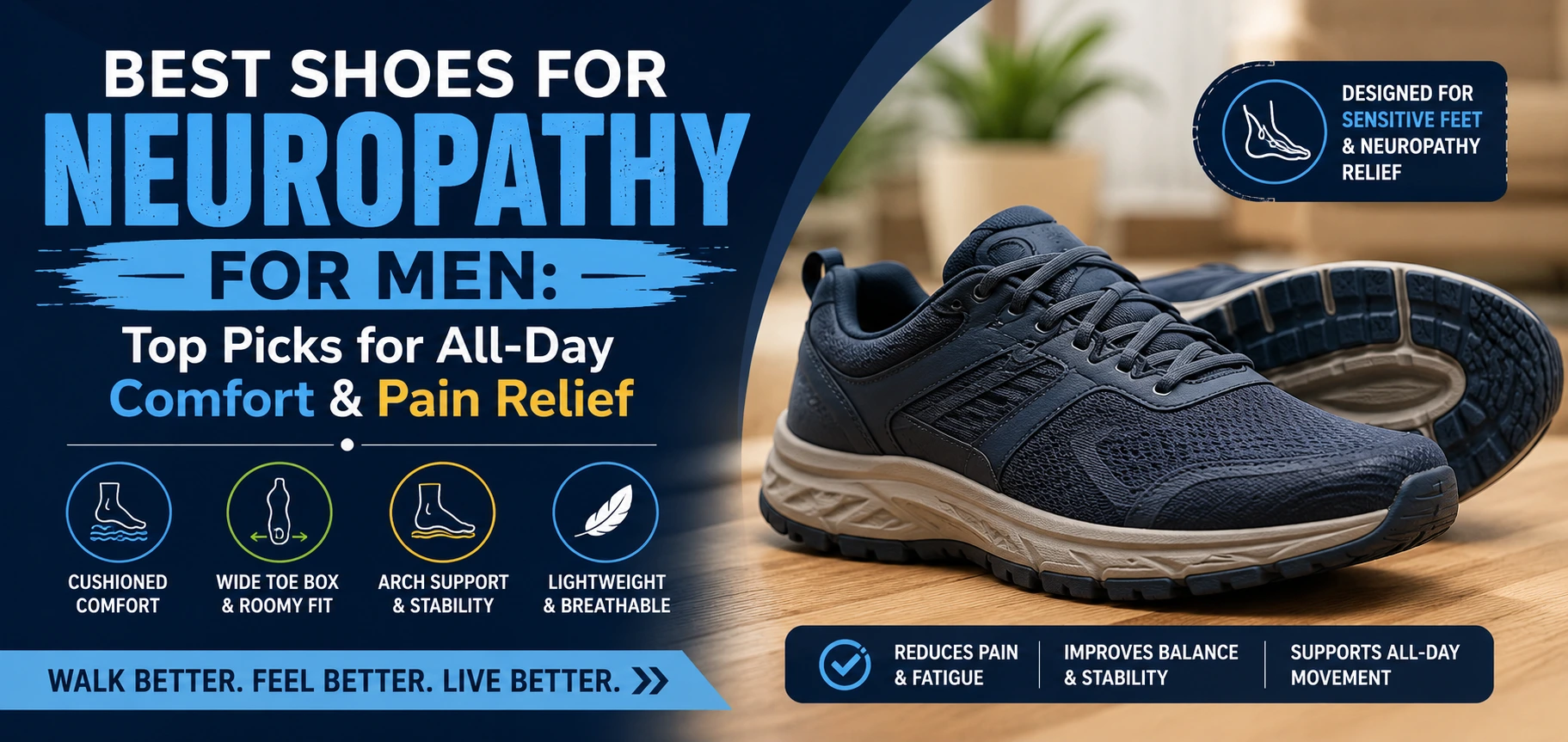
If your feet burn, tingle, or go numb by the end of the day, you already know that not just any sneaker will do. Ask anyone who’s dealt with it for a while, and they’ll tell you the same thing I’ve heard from podiatrists and patients alike: the wrong shoe doesn’t just feel uncomfortable — it can actually make nerve pain worse.
So here’s the short answer, right up front, because I know you didn’t come here for a 3,000-word history of foot anatomy. The best shoes for neuropathy for men share four things in common: a wide, deep toe box, minimal seams inside the shoe, a firm (not mushy) sole with good shock absorption, and enough room to fit an orthotic or diabetic insert if you need one. Brands like Orthofeet, New Balance’s 990 and 928 lines, Skechers Arch Fit, and Propet all show up again and again in this space for good reason — they’re built with those exact features in mind.
That’s the summary. Now let’s get into why it matters, what to actually look for, and which specific shoes are worth your money.
Why Regular Shoes Make Neuropathy Worse
Here’s something most shoe articles skip: neuropathy doesn’t just cause pain, it also reduces your ability to feel pain in a normal way. That sounds contradictory, but it’s not. A lot of men with peripheral neuropathy — especially the diabetic kind — lose sensation in their feet even while dealing with burning or tingling sensations elsewhere. That combination is dangerous. You could be developing a blister or a pressure sore inside your shoe and not even notice until it’s infected.
I mention this because it changes how you should shop. You’re not just looking for “comfortable” shoes. You’re looking for shoes that protect feet you may not be able to fully feel. That means no rough interior seams, no tight pinch points, and no shoes that “just need to be broken in.” If a shoe feels wrong on day one, it’s wrong. Full stop.
What to Actually Look for in Neuropathy Shoes
A friend of mine who’s a nurse and has managed her father’s diabetic foot care for years put it simply: “You’re not shopping for style first. You’re shopping for a shoe that won’t hurt him without him knowing it.” That stuck with me, and it’s the filter I’d suggest you use too.
Wide and deep toe box. Your toes need room to sit flat and spread naturally. A narrow toe box compresses nerves and can cause numbness that has nothing to do with your underlying condition — it’s just the shoe.
Seamless or minimal-seam interior. Stitching lines inside a shoe rub against skin thousands of times over the course of a day. If you can’t feel that rubbing happening, it can turn into a wound before you realize it.
Firm midsole with cushioning. You want shock absorption, yes, but not a mattress-soft sole that lets your foot roll or wobble. Stability matters as much as softness, maybe more.
Removable insoles. This one’s non-negotiable if you use custom orthotics or diabetic inserts. A shoe with a glued-in insole is basically useless to you.
Adjustable closures. Feet swell throughout the day, especially for men managing diabetes. Velcro straps or laces that let you adjust the fit hour to hour beat a fixed slip-on almost every time.
Non-binding, breathable uppers. Stretchy mesh or soft leather that moves with your foot instead of fighting it.
The Best Shoes for Neuropathy for Men — Actual Picks
I’m not going to pretend every shoe on this list will feel the same to every reader. Foot shape, the severity of your neuropathy, and whether you’re dealing with diabetes-related nerve damage or something else all change what “best” means for you. Still, these are the shoes that consistently show up recommended by podiatrists, worn by real patients, and reviewed well by men specifically managing neuropathy.
1. Orthofeet Coral Stretch Knit Sneaker
This is probably the single most-recommended shoe in podiatry circles for neuropathy, and it earns the reputation. The knit upper stretches around bunions and swelling, there’s a wide toe box, and the removable insole has extra cushioning already built in — so even without a custom orthotic, most men find it comfortable straight out of the box.
Trade-off: it’s not the most stylish shoe out there. If you need something for the office, this leans casual.
2. New Balance 928v3
This is the shoe I’d point to if you want something that looks like a “normal” sneaker but is built almost like a medical device underneath. It’s Medicare-approved as a diabetic shoe, has a roomy toe box, and the ROLLBAR support system helps with stability if your balance is affected by nerve damage — which, if you’ve had neuropathy for a while, you know can happen.
Trade-off: it runs on the heavier side compared to lifestyle sneakers.
3. Skechers Arch Fit Work Shoes (or the everyday Arch Fit line)
Skechers isn’t always taken seriously in medical shoe conversations, but the Arch Fit line genuinely holds up. The molded footbed does a lot of the arch-support work for you, which matters if you’re not using a custom insert. Good for men who are on their feet a lot during the day — retail workers, warehouse staff, anyone who’s clocking 8+ hours standing.
Trade-off: the arch support is built-in and not always removable in every model, so check before buying if you need to fit your own orthotic.
4. Propet Stability Walker
If balance is a real concern — and for a lot of men with advanced neuropathy, it is — this shoe was basically designed around that problem. It’s got a wider base and more structured ankle support than most walking shoes, at the cost of looking a bit more “orthopedic.”
Trade-off: not a shoe you’ll wear out to dinner, but genuinely reassuring on uneven ground.
5. Dr. Comfort Ranger / Winner (Diabetic-Specific Lines)
These are built specifically for diabetic feet, with seam-free interiors and protective toe boxes as standard, not an upgrade. If your neuropathy is diabetes-related, this brand was quite literally made with your situation in mind.
Trade-off: pricier, though often at least partially covered by Medicare or insurance if you have a documented diabetic foot condition — worth asking your doctor about.
Women vs. Men: Does the Shoe Actually Matter?
Quick note here because it comes up a lot: the core features that matter for neuropathy — wide toe box, seamless interior, firm cushioning, removable insoles — are identical for men and women. The difference is mostly in sizing, width options, and styling. Most of the brands above (Orthofeet, New Balance, Propet, Dr. Comfort) make near-identical versions in women’s sizing and last shapes, so if you’re shopping for a woman in your life, you’re looking at the same short list, just a different size run.
A Word on What Shoes Can’t Fix
I want to be straight with you here instead of overselling this. Good shoes reduce pressure, friction, and instability — three things that genuinely make neuropathy symptoms worse. What they can’t do is treat the nerve damage itself. If you’re dealing with burning, tingling, or numbness that’s new or getting worse, that’s a conversation for a doctor or podiatrist, not something to shoe-shop your way out of. Custom orthotics, in particular, are worth asking about — a $150 pair of shoes with a $40 pair of properly fitted inserts often outperforms a $250 “premium” shoe worn with generic insoles.
Quick Buying Checklist Before You Order
- Toe box: can you wiggle all five toes without them touching the sides?
- Interior: run your hand inside — any raised seams near the toes or heel?
- Sole: press down on the midsole. Does it feel supportive or does your finger sink right through?
- Insole: is it removable, in case you need to swap in an orthotic later?
- Closure: laces or velcro that adjust, not a fixed slip-on, unless swelling isn’t an issue for you
- Return policy: buy from a retailer with an easy return window — comfort is impossible to judge from a product photo
Frequently Asked Questions
1. What are the best shoes for neuropathy?
Shoes with a wide, seamless toe box, firm cushioned soles, and removable insoles tend to work best. Orthofeet, New Balance 928v3, and Dr. Comfort’s diabetic lines are commonly recommended by podiatrists.
2. What are the best shoes for foot neuropathy specifically?
Look for shoes marketed as diabetic or neuropathy-specific footwear — they’re built with seam-free interiors and extra depth for orthotics, which matters most when nerve pain is concentrated in the feet.
3. What are the best shoes for men with neuropathy?
Balance 928v3, Orthofeet Coral, and Propet Stability Walker are strong starting points for men, especially if balance or diabetic foot care is part of the picture.
4. Are Skechers good for neuropathy?
The Arch Fit line specifically is reasonably good, thanks to its molded support footbed. Not every Skechers shoe qualifies, though — check for wide-fit options and avoid narrow lifestyle sneakers.
5. What’s the best walking shoe for neuropathy?
For regular walking, New Balance 928v3 or Orthofeet’s walking-specific models hold up well, offering stability plus enough cushioning to reduce impact on sensitive feet.
6. Do diabetic shoes actually help with neuropathy?
Yes, in that they reduce friction, pressure points, and the risk of unnoticed injury. They don’t reverse nerve damage, but they lower the chance of complications like ulcers.
7. How do I know if a shoe’s toe box is wide enough?
Stand in the shoe and wiggle your toes. If they touch the sides or feel cramped, size up or try a wide-width version rather than assuming you’ll “break it in.”
8. Can I use my own orthotics in neuropathy shoes?
Most brands built for neuropathy (Orthofeet, New Balance 928, Dr. Comfort) have removable insoles specifically so you can swap in custom orthotics.
9. Are neuropathy shoes covered by insurance or Medicare?
, yes, if you have documented diabetic peripheral neuropathy and a doctor’s prescription — Medicare’s Therapeutic Shoe program covers part of the cost for qualifying patients. Check with your provider directly.
10. What’s the difference between neuropathy shoes for men and women?
Mainly sizing and width options — the underlying design features (wide toe box, seamless interior, firm sole) are the same for both.
11. Do I need a podiatrist to pick the right shoe?
Not strictly, but it helps, especially if you have diabetes or advanced nerve damage. A podiatrist can assess your gait and recommend custom inserts that off-the-shelf shoes can’t replace.
12. Can wearing the wrong shoes make neuropathy pain worse?
Yes. Tight, poorly cushioned, or seam-heavy shoes increase pressure and friction, which can intensify burning and tingling sensations even though the shoe itself isn’t causing the nerve damage.
13. Are slip-on shoes a bad idea for neuropathy?
automatically, but they’re riskier if your feet swell during the day, since you lose the ability to adjust fit. Adjustable closures are generally the safer choice.
14. What brands do podiatrists recommend most for neuropathy?
Orthofeet, New Balance, Dr. Comfort, and Propet come up most often in podiatry recommendations, largely because they were designed with diabetic and neuropathic feet in mind from the start.
15. How often should I check my feet if I wear neuropathy shoes?
Daily is the standard advice, especially if sensation is reduced. Even a well-designed shoe can cause unnoticed irritation, so a quick visual check each evening is worth the habit.
