
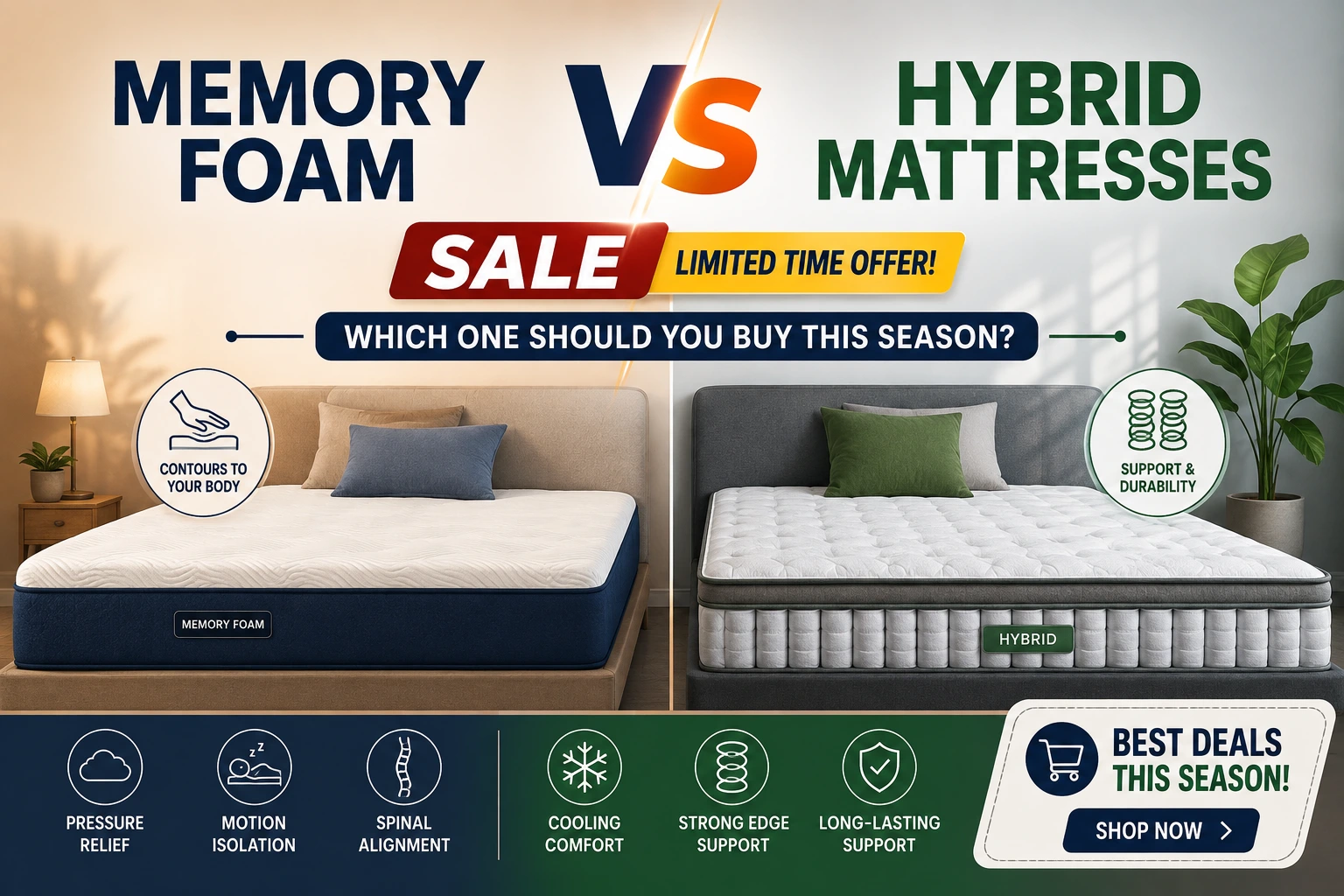
The Quick Answer (Before You Keep Scrolling)
If you sleep hot, share a bed, or switch positions all night, go hybrid. If you deal with back or shoulder pain and sleep mostly on your side, memory foam is usually the better call — especially when it’s on sale, since a good foam mattress at a discount can outperform a mid-range hybrid at full price.
That’s the short version. But mattress shopping during a sale event is its own weird little sport — retailers throw around “60% OFF” banners so often that the number stops meaning anything, and you’re left comparing two very different sleeping surfaces without really knowing what separates them. I’ve bought three mattresses in the last eight years (one memory foam, two hybrids), returned one of them, and talked to enough sleep-product reps at trade shows to know where the marketing fluff ends and the real differences begin. Let’s get into it.
Memory Foam vs Hybrid Mattresses: The Comparison Chart
Here’s a straightforward table comparing memory foam vs hybrid mattresses across the things that actually matter when you’re lying on one at 2 a.m.
| Feature | Memory Foam | Hybrid |
|---|---|---|
| Core material | Multiple layers of viscoelastic foam | Foam or latex comfort layer + pocketed steel coils |
| Feel | Slow-sinking, “hug” sensation | Foam contouring on top, springy bounce underneath |
| Temperature | Tends to trap heat unless gel-infused or open-cell | Coils allow airflow, sleeps noticeably cooler |
| Motion transfer | Very low — great for couples | Low to moderate, depends on coil quality |
| Edge support | Weak, foam compresses near the edge | Strong, coils hold their shape at the perimeter |
| Weight/setup | Heavier per inch of foam, harder to move alone | Slightly lighter overall, easier to rotate |
| Average lifespan | 7–10 years | 6–8 years (coils wear faster than foam) |
| Typical sale price | $400–$900 for queen (discounted) | $600–$1,200 for queen (discounted) |
| Best for | Side sleepers, pressure-point pain, hot-natured partners not an issue | Combo sleepers, stomach sleepers, couples with different preferences |
A quick gut-check on that chart: coil count and foam density matter more than brand name. I’ve seen $1,500 hybrids with cheap 200-coil bases that sag within two years, and $700 foam mattresses that held their shape for nearly a decade because the base layer was high-density support foam instead of cheap filler foam. Read the spec sheet, not just the ad copy.
Where People Search for This Comparison — And Why It Gets Confusing
A lot of shoppers land on this topic after seeing a mattress comparison chart on Reddit or a forum thread where someone posted their own version of memory foam vs hybrid mattresses nearby options they found at a local store. That’s honestly not a bad way to research — real buyers tend to be blunter about sagging, off-gassing smell, and return hassles than most brand websites are. Just take individual Reddit threads with a grain of salt; one person’s “way too firm” is another person’s “finally, back support.”
If you’re looking at an innerspring vs memory foam vs hybrid comparison specifically, remember that hybrids exist because pure innerspring mattresses lacked pressure relief and pure foam lacked support and airflow. A hybrid is essentially the industry’s attempt to split the difference — coils for support and bounce, foam for comfort and contouring.
Memory Foam: What You’re Actually Buying
Memory foam was originally developed by NASA in the 1960s for airplane seat cushioning — not a myth, that part’s true, though the “space-grade technology” language mattresses use today is mostly marketing. What matters for your sleep is density and layering.
Where memory foam wins:
- Pressure relief for hips and shoulders (great if you’re a side sleeper)
- Near-silent, since there are no coils to squeak
- Absorbs motion, so a restless partner won’t wake you
- Often cheaper than hybrids in the same comfort tier, especially during sale events
Where it falls short:
- Heat retention — even “cooling gel” foam runs warmer than a hybrid, in my experience it just delays the heat buildup rather than eliminating it
- Slower response time, which some people find suffocating if they move around a lot
- Weak edge support, so the mattress feels smaller than its actual size
- New foam mattresses often have an off-gassing smell for the first 24–72 hours — normal, but worth knowing before you unbox one in a small bedroom
Hybrid: What You’re Actually Buying
A hybrid mattress puts a comfort layer (usually 2–4 inches of foam or latex) on top of a coil support system, usually pocketed coils wrapped individually in fabric so they move independently instead of as one connected spring unit like old-school innerspring beds.
Where hybrids win:
- Better airflow, so hot sleepers genuinely feel the difference
- More “give” and bounce, which helps if you sleep on your stomach or switch positions a lot
- Stronger edges, useful if you sit on the side of the bed to put shoes on, or share a queen with a partner and need the full surface usable
- Feels more like a traditional mattress, which matters if you’re coming off an old innerspring and don’t want too drastic a change
Where they fall short:
- More expensive on average, even during a sale
- Heavier and bulkier, tougher to flip or rotate solo
- Coils can develop a faint metallic creak over time, especially in cheaper models
- Not as good at isolating motion as pure foam — you’ll feel your partner roll over more
A Real Example: My Own Mattress Swap
I switched from a mid-range memory foam mattress to a hybrid about two years ago, mostly because I run hot and was waking up sweaty even with the AC on. The hybrid fixed that almost immediately — noticeably cooler within the first week. But I also noticed my lower back, which had felt fine on the foam, started aching slightly on the hybrid until I adjusted the base to a slightly softer setting. That’s the trade-off nobody tells you about clearly enough: fixing one problem (heat) can quietly introduce another (firmness mismatch) if you don’t test the specific model’s firmness rating before buying, not just the category.
How to Actually Use a Sale (Without Getting Played)
Sale events are when most people make this decision, so a few practical notes:
- Compare against the “true” price, not the crossed-out one. Many mattress brands inflate the “original price” so the sale looks bigger. Check price-tracking tools or the brand’s price history if you can.
- Trial periods matter more than discounts. A 100-night trial with free returns is worth more than an extra 10% off, because you genuinely can’t judge a mattress in a showroom in five minutes.
- Buy a protector at the same time. Almost every mattress return policy requires the mattress to be free of stains — a $30 protector protects a $150+ investment.
- Don’t assume “hybrid” means better. It’s often priced higher because of manufacturing cost, not because it’s objectively superior. It suits different sleep needs, that’s it.
Memory Foam vs Hybrid: Quick Decision Guide
- Side sleeper with hip/shoulder pain → Memory foam
- Hot sleeper or live somewhere humid → Hybrid
- Share a bed with a restless partner → Memory foam
- Sit on the edge of the bed often → Hybrid
- Tight budget, want best value on sale → Memory foam (usually cheaper per comfort tier)
- Coming from an old innerspring, want a gentler transition → Hybrid
- Stomach or back sleeper needing more bounce/support → Hybrid
Bottom Line
Neither one is objectively “better” — that’s not a cop-out, it’s just how mattresses work. A memory foam mattress on sale can be the smarter buy for pain relief and price. A hybrid earns its higher price tag through temperature control and edge support. The real mistake isn’t picking the “wrong” category — it’s buying based on the discount percentage instead of your actual sleep habits.
Frequently Asked Questions
1. Is a hybrid mattress worth the extra money over memory foam?
It depends on your priorities. If temperature and edge support matter to you, yes. If pressure relief and price matter more, memory foam usually gives better value per dollar.
2. Which is better for back pain, memory foam or hybrid?
Memory foam is generally better for pressure-point pain (hips, shoulders), but firmness level matters more than category. A too-soft mattress in either type can worsen back pain.
3. Do hybrid mattresses sleep cooler than memory foam?
Yes, in almost all cases. The coil layer allows airflow that solid foam layers don’t, even with gel-infused or “cooling” foam technology.
4. How long does a memory foam mattress usually last?
Around 7 to 10 years with proper care, slightly longer than most hybrids because there are no coils to lose tension over time.
5. Why do hybrid mattresses cost more than memory foam ones?
Manufacturing cost is higher — combining a coil support system with a foam comfort layer requires more materials and labor than an all-foam build.
6. Is memory foam bad for hot sleepers?
It can be, since foam retains body heat more than coil-based mattresses. Gel-infused or open-cell foam helps, but doesn’t fully solve it.
7. Can I use a table comparing memory foam vs hybrid mattresses to decide firmness too?
A comparison chart is useful for the material and feel differences, but firmness is usually rated separately (soft, medium, firm) and varies by specific model, not just by category.
8. Are hybrid mattresses good for couples?
Generally yes, especially with pocketed coils, because they offer good edge support and moderate motion isolation, though pure memory foam still isolates motion better.
9. What’s the difference between hybrid and innerspring mattresses?
Innerspring mattresses have a thin comfort layer over a connected coil system. Hybrids use a thicker foam or latex comfort layer over individually wrapped coils, giving more contouring than traditional innerspring.
10. Is it normal for a new memory foam mattress to smell?
Yes, this is called off-gassing and it’s common with new foam products. It usually fades within a few days if the room is well-ventilated.
11. Should I buy during a mattress sale or wait?
Major sale periods (holiday weekends, end-of-season clearances) tend to offer genuine discounts. Outside of those windows, “sales” are often just the regular price with different marketing.
12. Do memory foam mattresses sag faster than hybrids?
It depends on foam density more than category. High-density memory foam can outlast a low-quality hybrid with thin coils and cheap foam layers.
13. Which mattress type is better for stomach sleepers?
Hybrids tend to work better for stomach sleepers because the added bounce and support help keep the spine aligned, whereas foam can let the hips sink too deep.
14. Can I find a good hybrid mattress on sale under $700?
possible, especially during major sale events, but check coil count and foam density carefully — very cheap hybrids sometimes use thin coil gauges that wear out fast.
15. Is there a big difference between memory foam and hybrid mattresses for side sleepers?
Yes. Memory foam typically contours better to the shoulders and hips, which reduces pressure points — a common issue for side sleepers on firmer hybrid models.
