Deciding between an online-first business and a traditional brick-and-mortar model is the most consequential choice an entrepreneur faces. While both aim to solve consumer problems and generate revenue, they operate under fundamentally different economic and operational rules. Understanding these distinctions is essential for selecting a path that aligns with your capital, risk tolerance, and long-term vision.
Operational Realities and Overhead Costs
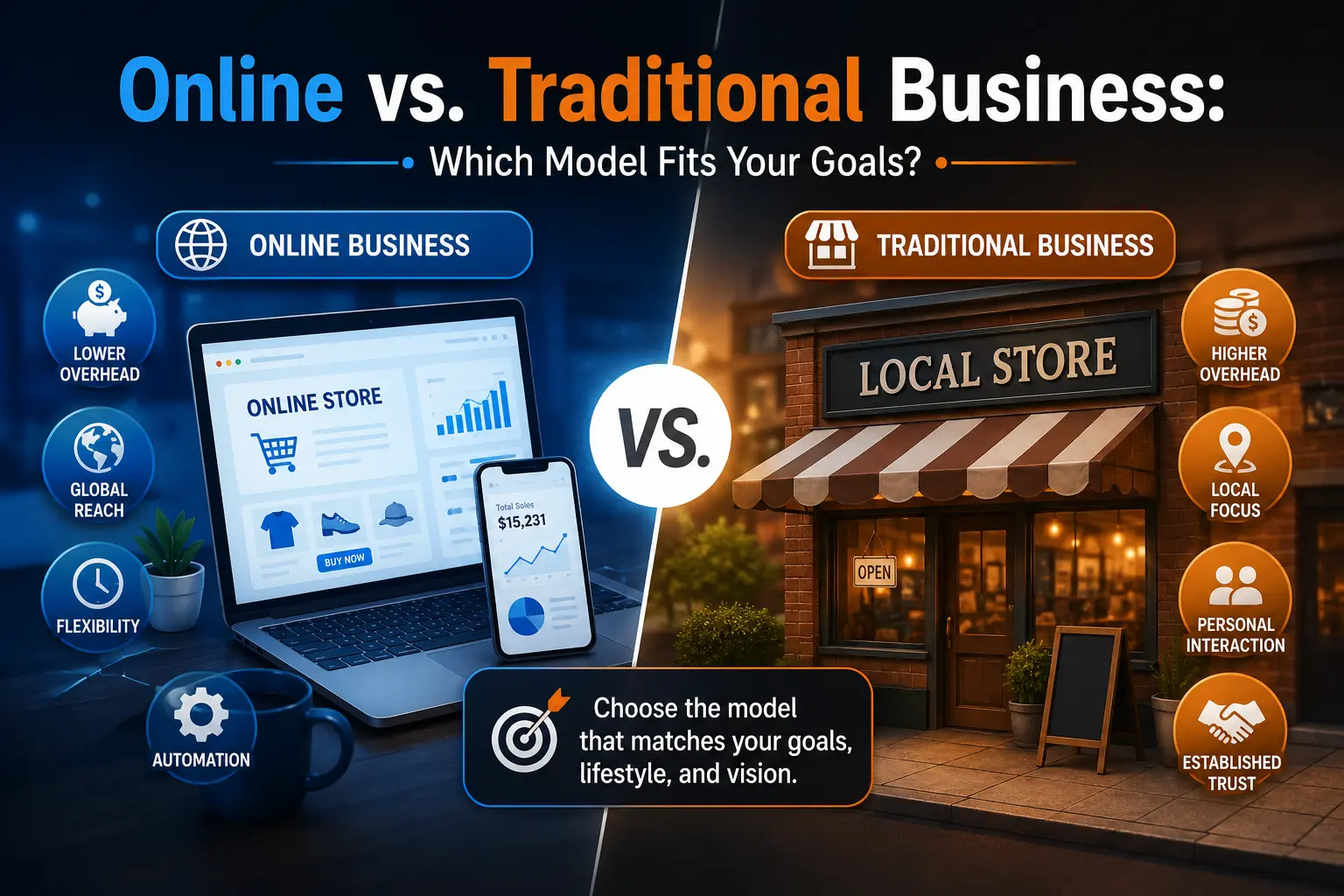
The primary difference between these models lies in their physical requirements. Traditional businesses rely on high-visibility real estate, requiring upfront investment in leases, interior design, and local utility infrastructure. Conversely, online businesses prioritize digital assets, shifting capital from rent and storefront maintenance toward web development, cybersecurity, and digital marketing.
-
Geographic Reach: A traditional business is bound by its physical location, creating a natural limit on the customer base it can serve daily. Online platforms, however, operate globally, allowing you to reach markets regardless of time zones or borders.
-
Customer Experience: Physical locations offer sensory benefits, such as the ability for customers to touch products or enjoy face-to-face service. Digital businesses must compensate by creating immersive, high-trust user interfaces and responsive automated support.
-
Operating Hours: Brick-and-mortar entities are usually constrained by set opening times, which directly impacts labor costs. Digital stores operate 24/7, enabling consistent revenue generation without the need for manual presence at all hours.
-
Scalability Barriers: Scaling a traditional model often requires replicating the physical infrastructure in new locations, leading to linear cost increases. Digital scaling is typically exponential, as software can handle 10,000 customers nearly as easily as it handles 10.
Managing Growth and Customer Acquisition
The methods for attracting and retaining clients differ significantly between these business types. Traditional models rely heavily on community presence and word-of-mouth, while online models are defined by precision targeting and data-backed marketing funnels.
-
Marketing Precision: Digital businesses use specific search intent and behavioral data to show ads only to interested individuals. Traditional stores depend more on catchment areas, local signage, and community networking.
-
Interaction Frequency: Online models gather vast amounts of data on how visitors move through a site, allowing for rapid A/B testing and feature optimization. Traditional stores gather qualitative feedback from staff-to-customer interactions, which can be harder to quantify but often leads to deeper loyalty.
-
Inventory Dynamics: Online businesses can utilize drop-shipping or on-demand manufacturing to minimize upfront inventory risk. Traditional businesses typically must hold stock on-site, requiring careful forecasting to manage shelf space and prevent dead capital.
-
Feedback Loops: Digital platforms facilitate instant, public reviews that influence future buyers globally. Traditional businesses benefit from direct human connection, which can diffuse issues before they escalate to public feedback.
Strategic Decision-Making: Risk and Resilience
A resilient business often balances elements of both worlds. While an online store offers speed and low entry costs, a physical presence provides a layer of local authority and brand legitimacy. The most successful modern enterprises often leverage an “omnichannel” approach, using a physical space to build sensory trust while maintaining an online engine to facilitate global growth and efficient transactions.
Ultimately, your choice should depend on where your customer lives and how they prefer to interact with your category. If your business depends on expert human consultation or high-end physical experiences, the traditional model remains superior. If your product is easily replicable, digital-first, or designed for global utility, an online model provides the speed and flexibility needed to outpace traditional competitors.
Frequently Asked Questions
1. Is it cheaper to start an online business? Generally, yes. Eliminating the need for retail space, furniture, and localized staff reduces initial capital requirements. However, online businesses often face higher ongoing costs in digital advertising and constant technology maintenance to stay competitive.
2. Can a traditional business survive without an online presence? Most businesses now require a “digital footprint” to survive. Even if your primary revenue comes from a storefront, you need digital visibility—such as search engine listings and social proof—to help local customers find and trust you.
3. Which model offers better customer loyalty? Both have strengths. Traditional businesses excel at building deep, local emotional connections through face-to-face interaction. Online businesses excel at building loyalty through personalized experiences, data-driven convenience, and global community building.
4. How do I decide which model is right for me? Analyze your product. Does it require a physical experience or expert, face-to-face guidance? If yes, consider traditional. If it is a commodity, a digital service, or something that can be easily shipped, the online model offers superior scalability.
5. What is an omnichannel business model? An omnichannel business is one that exists both physically and digitally. It allows customers to browse online and buy in-store, or vice versa, creating a unified brand experience that captures the strengths of both models.
